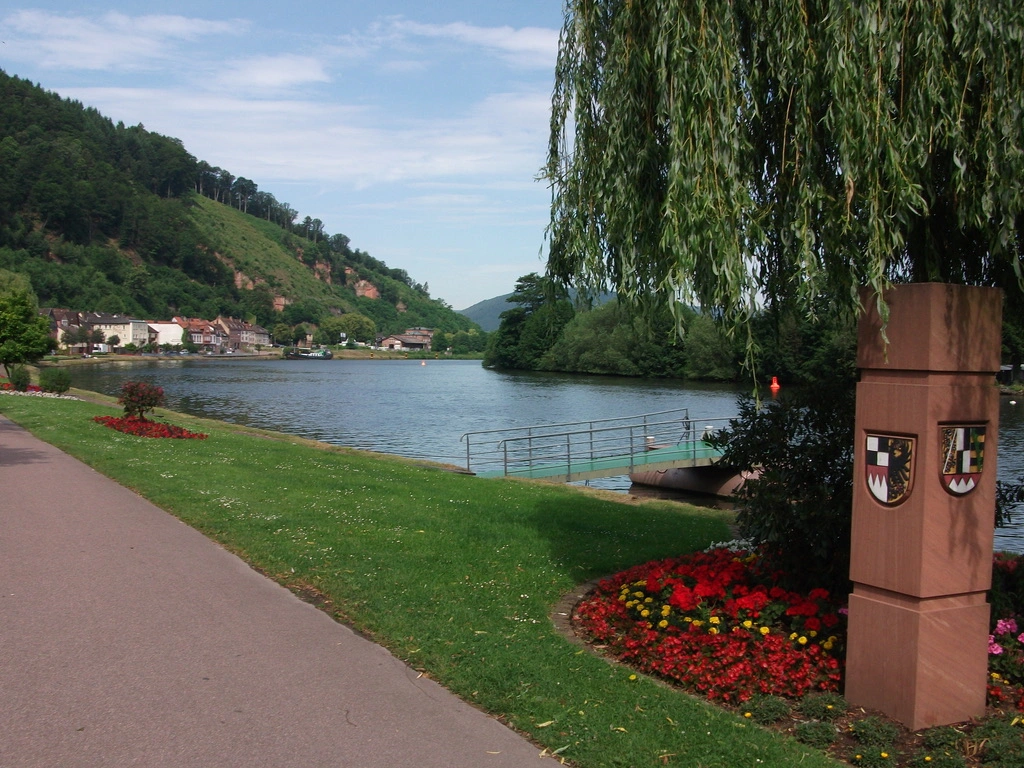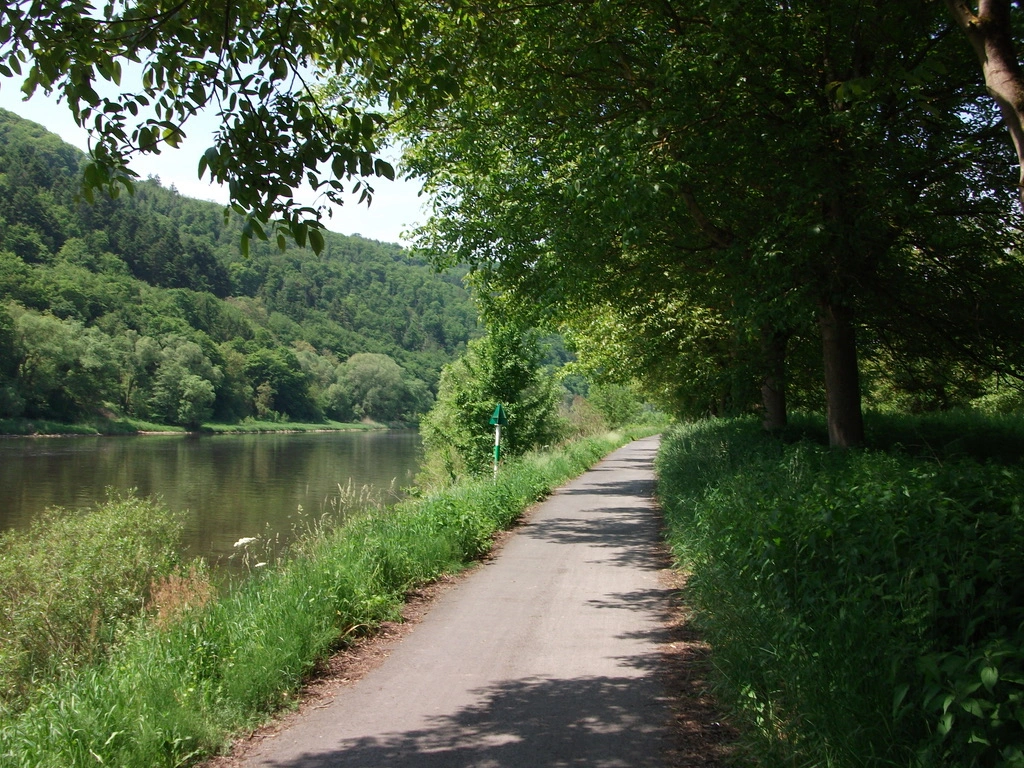
Mosel River bikepath near Nehren, 25 May 2010
THE BLURBS
The short blurb:
Michael Healy is a fake German disguised as a real Australian. He has lived in both countries.
The long blurb:
Michael Healy is an Australian writer who has lived in Alice Springs, Melbourne and Sydney in Australia, as well as Göttingen, Bonn and Berlin in Germany.
He has written ten novels, three books about Germany, eight German travel tripalogs with fotos and commentary in PDF, five books of tales, two collections of poetry, and fourteen plays, five of which have been performed at various Melbourne venues, including La Mama Theatre, Northcote Town Hall, Voltaire and The Butterfly Club.
Michael has a long-standing interest in Germany and a fair amount of his work is set there. He has a particular interest in how nationality shapes people.
He also has an interest in dormancy and latency in human relationships - how long-forgotten emotions can turn out to be alive and powerful despite, and because of, the passage of time.
He is now old enough to have seen how youthful states of mind can come to be re-seen with age and reveal new redemptive possibilities.
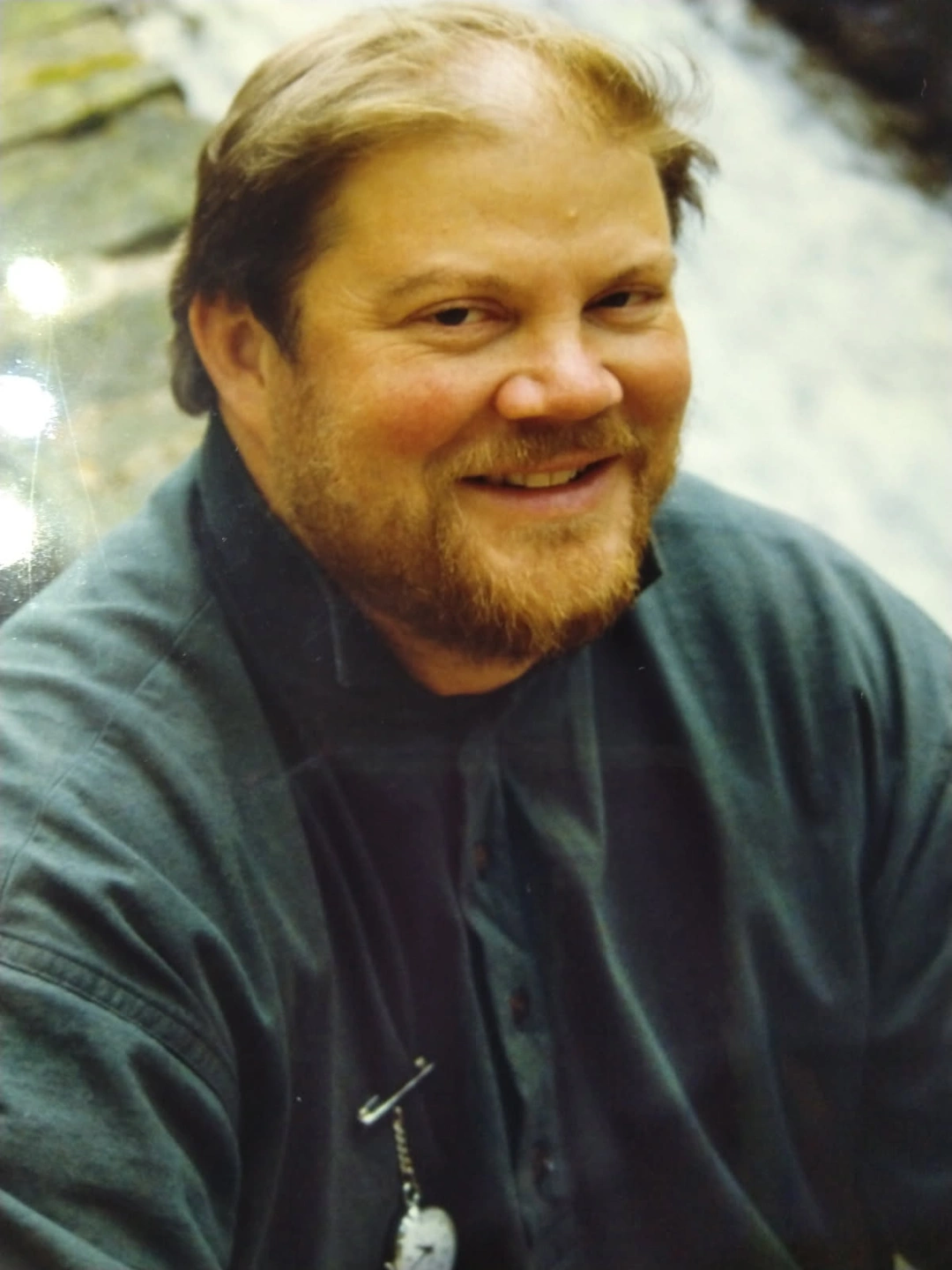
Me next to a Dutch stone-lined cascade, Vrijenberg [Fryenberg], 5 May 1993
Email:
My books are buyable on Amazon:
www.amazon.com/author/michaelhealy
As of 2 June 2024, 18 of my books are available to read online at trove.nla.gov.au. This is the National Library of Australia edeposit (NED) which makes unpublished books available to read online. (In my case this was done in conjunction with the State Library of Victoria, as required by the copyright laws of Australia.) Till they are better catalogued the best way to access them is to put in search:
MICHAEL HEALY + TITLE (see My Works for the titles).
This will take you directly to the book, which you can read online. (If you just enter 'Michael Healy' my books won't appear till page 3 of the search results. It's not a great search engine - all sorts of non Michael Healy stuff gets in the way, unfortunately.) More recent books will shortly also be uploaded onto NLA Trove.
(see below for titles. This allows read only online.)
LATEST NEWS
GERMAN THINKING AND HOW IT HAS INFECTED THE WORLD FOR THE WORSE
Buried in my works are passages that highlight the harm that German poets and philosophers have wrought upon the nations and peoples of the earth. This is a gathering of those passages, so you don't have to wade through my fiction and non-fiction to find them. I'm doing this because most people have no idea of the harm that German thinkers have caused... or they do realise this, as per Nazism and communism, but they don't realise where it comes from. People need to understand where this harmful thinking comes from, and realise the extent of its embedding in our customary ways of thinking, to our detriment. 48 pages, 14,000 words
September 2026
Now added to DERISION, making that book 152 pages and 39,000 words
TRANSLATIONS - all done in 2026
REWRITING HÖLDERLIN - 73 poems translated by Michael Healy - with commentary 243 pages
BEYOND HÖLDERLIN - with no commentary, but with an afterword - 197 pages
HÖLDERLIN PURE - without commentary or foreword / afterword - 191 pages
RILKE - THE DUINO ELEGIES - translated by Michael Healy, with notes - 95 pages
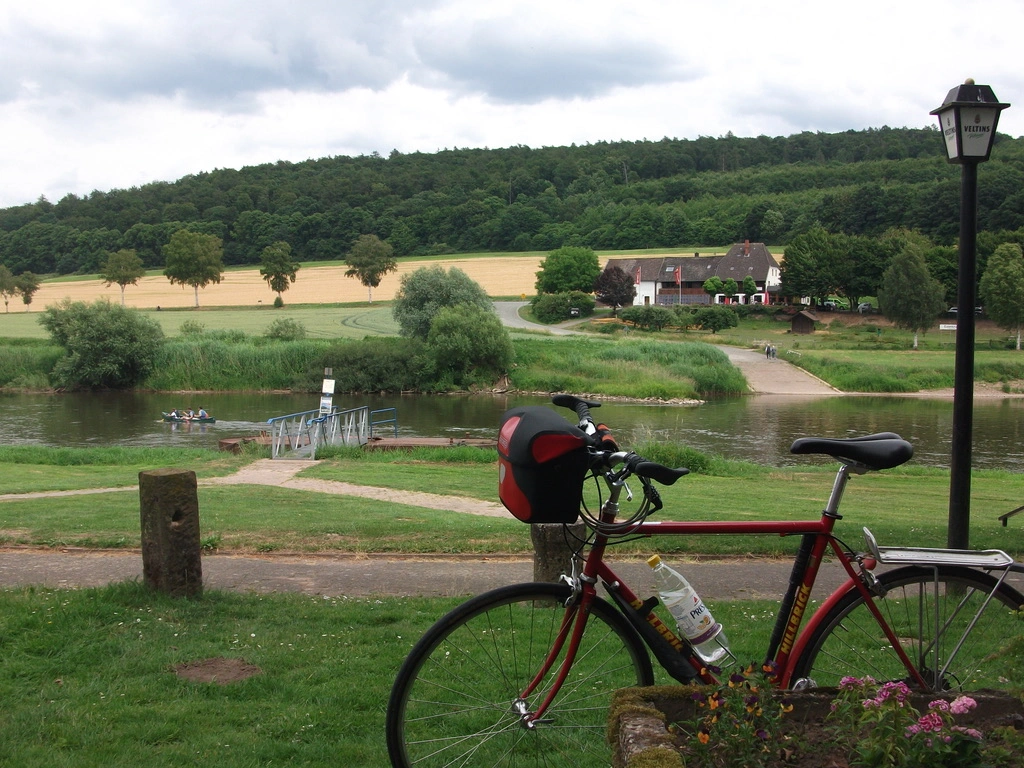
My bike at the Wehrden Fährklause pub on the Weser River, 16 June 2018
MY NOVELS
(in reverse order of writing)
SGIAN DUBH (pronounced SKEE-AN DOO)
Tells of a young man and a young woman who meet in an inner-city sharehouse in Melbourne in the 1980s. They become close without becoming boyfriend-girlfriend. They move into another house together, becoming a couple in every respect but remain chaste for a decade. Eventually this becomes untenable and they stop living together, but stay friends. The man finds his mate but the woman stays unmated. A tale of a strange love that gets in the way of normal happiness but perhaps achieves a different kind of happiness of its own. 133 pages, 44,000 words. Written January 2021.
BY DINT OF GRACE
Rowena grew up in a strict Puritan sect and as a result had trouble finding her way in the world. Ross felt for her and tried to smooth her way. A chronicle of the times of togetherness in the lives of a man and a woman who knew each other all their adult lives. Episodes & scenes, transitions and transformations, resistances and realisations. Their mismatch and their common ground. Their attraction and their repulsion. And what happened to them in the end.
101 pages, 27,000 words. Written in 2019.
REDMOND STREET - a tale of redemption
An older man recalls a youthful misadventure with a young woman he'd fancied and thirty years later seeks to make good his rebuffed advance. He is surprised at the response he gets. It triggers off a series of events that changes his life and that of the woman who'd been at the back of his mind for all his adult life. A late-life echo of a failed youthful moment sees it redeemed.
113 pages, 28,000 words. Written in 2017.
I SET OFF AT TEN
Graham Watson is fifty-five year old man who is trying to re-find his places in the world after his wife's death from a prolonged illness. Released at last from his servitude to that illness, he starts to take up options hitherto not possible to him. He restructures his life and finds his earthly paradises: one in Australia and the other in Germany, a land he has known all his adult life. In so doing he finds himself reviewing his youth, its people and its lost opportunities, while establishing himself in the land of his dreams. In so doing he finds himself living in his own afterlife, redeeming himself and some of the people from his youth who he has lived apart from for most of his life. In this makeshift heaven on earth he finds joy and beauty in land and people beyond his hopes. I SET OFF AT TEN is an older man's Bildungsroman.
169 pages, 65,000 words. Written in 2016-17.
BAD SOODEN (SOODEN SPA)
('Bad' is pronounced 'bud'; 'Sooden' is pronounced a bit like a non-rhotic 'Sorden': Bud Sorden, as a Londoner or an Australian would say it, not like an Irishman or most Americans who roll their 'r's.)
A young Australian living in Germany with his girlfriend is seduced by an older woman on a train. A story of how raw lust becomes long-lasting love. It also shows how a young man comes to terms with a foreign country - how his attraction to it is shaped by its history and culture, its towns and countryside, its language and people. It shows how his youth is changed by this immersive encounter, sharpened by his falling in love with the older woman who fills needs he never knew he had. She finds too that he engages her in ways that her own countrymen hitherto haven't. Hence they find they complement each other in unexpected ways. Having found each other, they find they are infinitely better off than they were before they met. Low expectations of love, borne of disappointing experience, become inarticulate longings fulfilled and hopes exceeded.
167 pages, 49,000 words. Written in 2015.
NB: some feedback reckons that the title 'Bad Sooden' doesn't say much to readers with no German. If this is Bad Sooden, what's Good Sooden? 'Bad Sooden' literally means 'Bath Sooden', i.e. 'Sooden Spa'. I can't get past Bad Sooden - it's something I know and I can't undo that knowledge. It has symbolism for me, but I realise that's no use to others unless they speak German. Mind you, as one canny person said to me, there's nothing wrong with a bit of mystery, e.g. L'Annee derniere a Marienbad/Last Year in Marienbad. After all, who says you have to understand everything you read or see? The best books leave a residue of incomprehension and mystery anyway.
THE GREEN WOLF TRILOGY Green Wolf deals with three stages in the life and career of a German green activist.
Part 1 GREEN WOLF
centers on a young German couple, Tilman and Gudrun, both of whom are environmental activists living in the university town of Göttingen. With a history of activity together in Green Wolf, a radical but peaceful green group, they now find their paths diverging. Tilman has moved on to Greenfriends, a more conventional lobby group with a higher national and international profile, but Gudrun has become increasingly frustrated by the 'lack of results' of conventional protests and is drawn to terrorism instead. The story concerns the way this tension plays out between them and how the state responds. It shows how a well-intentioned impulse can unleash unforeseen consequences. It also deals with the differences between the generations in post-WW2 Germany and how various notions of political responsibility collide.
207 pages, 79,000 words. Written in 1998-1999.
Part 2 OUTLAW
Tilman is firmly established in Berlin as a professional environmental lobbyist with a national profile. He experiences frustration in keeping up his public persona. Provoked by a road rage incident he embarks on an anonymous car tireslashing campaign that antagonises the whole city. The city-wide hysteria triggered off by his night-time activities takes everybody by surprise, himself included.
137 pages, 52,000 words. Written in 1999-2000
Part 3 FLIGHT
Tilman increasingly finds his national notoriety encroaching on his privacy, freedom and anonymity. This becomes intolerable - so much so, that after a serious illness and much soul-searching, and key encounters with friends and strangers, he flees his life and his country. On the one hand it is a story of how someone becomes a ‘missing person’. On the other it shows how important decisions can take a long time to be made, and unwittingly involve all kinds of people and thinking. It is also a picaresque novel about Germany.
239 pages, 94,000 words. Written in 2000-2001.
FRIEDA
concerns two Berliners who meet in India and see aspects of each other they wouldn’t see at home. These unaccustomed recognitions cause each other great difficulty, with tragic consequences.
105 pages, 30,000 words. Written in 1986.
CICADA - A Psychogeographical Fantasia
deals with a miscellany of people who live on communes and in share houses in the 1980s. A mix of poetry and prose, it seeks to show how lives move through each other in relation to place. There are two sections. The first is set in Melbourne and South Eastern Australia. The second is set in Germany several years before. There is no story as such, though there are many stories within the 'no story'. There is much to do with how people are affected by distance and strangeness, and personal and cultural misunderstanding.
237 pages, 80,000 words. Written in the early 1980s.
Included at the end of CICADA:
BERLIN - HERE & THERE (1980) is a political reverie linking Berlin and Melbourne in the Cold War, when Berlin was divided between the Western powers and the Soviet Union. It explores some of the similarities and differences between East and West, communism and capitalism, and the blurring of the distinction between ‘here’ and ‘there’. Even in the nuclear heat of imperial black and white thinking, certainties were clung to, insisted upon, ignored, not applicable, dissolved... the navigation of notions was easier said than done, all with the threat of annihilation hanging over all certainties and confusions. They were difficult times and circumstances, and people lived as best they could, giving in to tyranny, subverting it, opposing it, all apparent opponents having more in common with each other than they were prepared to see or concede. All were living with ideologies they had no choice but to respond to, even if the resultant convictions and personae were less convincing than they were wished to be. (We were all paper tigers back then. Maybe we still are. Maybe we always are.) Lives were ruined and lived somehow, all testament to the power of ideologies to frame worlds that oppress us all, no matter if we oppose or agree. (Our individualistic Christian consciences prepare us ill for such eventualities, or for analysing them before, during and after their reign - which is why moralistic analyses of Nazism and communism are blind nonsense. Institutionalised totalitarian ideologies leave no room for the play of individual conscience - all defiance happens at risk of death. Individual conscience derives from a time when another all-encompassing ideology, Christianity, dominated lives within the framework of sin - where all sin happened at risk of hell in the after life for the individual sinner - a different kind of death, but death nonetheless.) And if Melbourne seems remote from Berlin, a periphery to a center, the outer is only outer in relation to an inner, hence both are part of the same whole: Pax Americana. In such times and terms, all is not what it seems, wherever and whoever you might think you are.
About 6,000 words.
In different forms, Berlin - Here & There won the Melbourne University Student Union Writing Prize in 1980 and 1981. It was published in Meanjin, issue 2, 1990. It is now included at the end of CICADA.
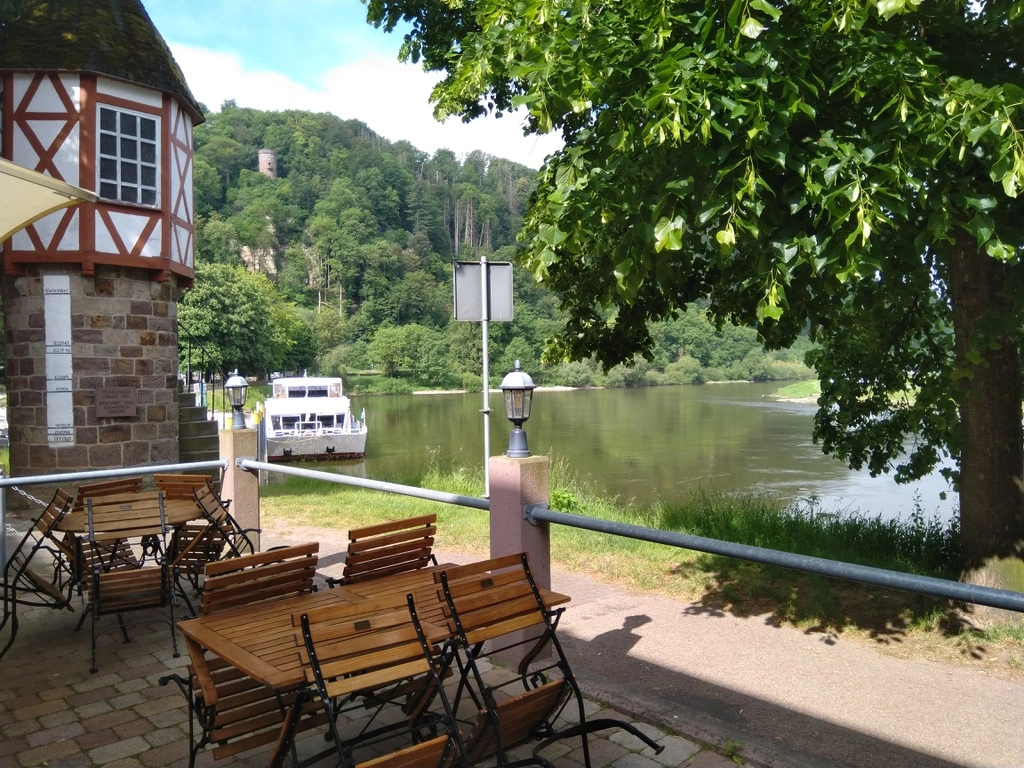
Hotel Zum Weserdampfschiff terrace on the Weser River at Bad Karlshafen, 1 June 2023
PLAYS / TALES
TALES FOR TRAIN AND PLANE: TROUBLESOME PEOPLE
The tales are my plays presented in a more readable form, without stage directions. They are entertaining short reads, good for an evening on the sofa with a glass of wine, or a couple of hours lie-in in bed with a cuppa or two.
THE QUIET LIFE
Robert is an expat Australian lawyer long resident in London. His old Australian friend Colin is coming to visit. Robert's wife Janet is unwilling to give up their backyard studio as a guest room because she has got used to having it as a room of her own. Colin's visit intensifies existing faultlines in the family, giving rise to serious tension. Robert’s daughter Emma's response to her parents' unhappy marriage also takes a disturbing turn. As well the visit tests Colin and Robert's long but unsatisfactory friendship, contrasting its youthful beginnings with its middle-aged reality. Robert seeks refuge in the company of his Chinese masseuse May. About 20,000 words. Written 2009.
HALFWAY HOUSE
Ken has long put up with his unhappy marriage to his alcoholic wife for the sake of the kids (despite involvements with other women). Now the kids are grown up he thinks he is at last free to escape his awful marriage. His friend Neil tries to match Ken to his old friend Ann who has been single all her life and craves a mate. Ken and Ann hit it off and soon after Ken moves into Ann's. However they find their ingrained domestic habits irritate each other - they are too set in their ways, with Ann in particular unable to adjust to living with someone else. Endless petty conflict ensues. Neil regrets playing the matchmaker and the worsening of his old friendships with Ken and Ann. In the end Ken and Ann separate. Ken quickly moves on to new female friends, Ann goes back to her loneliness to lick her wounds and feel sorry for herself, while Neil welcomes the restoration of his friendships - changed though they be - and reflects on the unforeseen consequences of his good intentions. About 19,000 words. Written 2010.
MOTHERHOOD
On the strength of her newspaper columns, Nora, a single mother at odds with her ex husband over her right to have primary custody of her child, is commissioned by a major publisher to write a book about her situation. Most of her family and friends disagree with the publisher's idea of making this a factual book, revealing real identities. Competing claims of betrayal as against truth telling get an airing. The book backfires on Nora, leaving her friendless and in danger of losing primary custody of her child. About 18,000 words. Written 2009.
NOTHING
Alice, 60, and Andrew, 40 have recently met and enjoy each other’s company. However Alice has a past that threatens to cut the friendship short. Ruth, who helped Alice out years ago when she was leaving her cruel husband, still claims Alice as hers alone and won’t tolerate any new friends Alice might have. Alice is in her thrall and doesn’t know how to escape. She appeals to Andrew to find a way out so they can get on with their lives in peace. About 11,000 words. Written 2012.
WOODFORD
Kate’s grandmother June refused to spend the night with her fiancé Ted during the war, wanting instead to wait till they were married. Shortly afterwards he was killed in action. June regretted her refusal for the rest of her life. Her bitterness affected her subsequent marriage and motherhood of Kate’s mother Sue. Through Kate, June sees a chance at redemption. The play traces the consequences of that fateful decision through three generations of women in the same family. About 12,000 words. Written 2011.
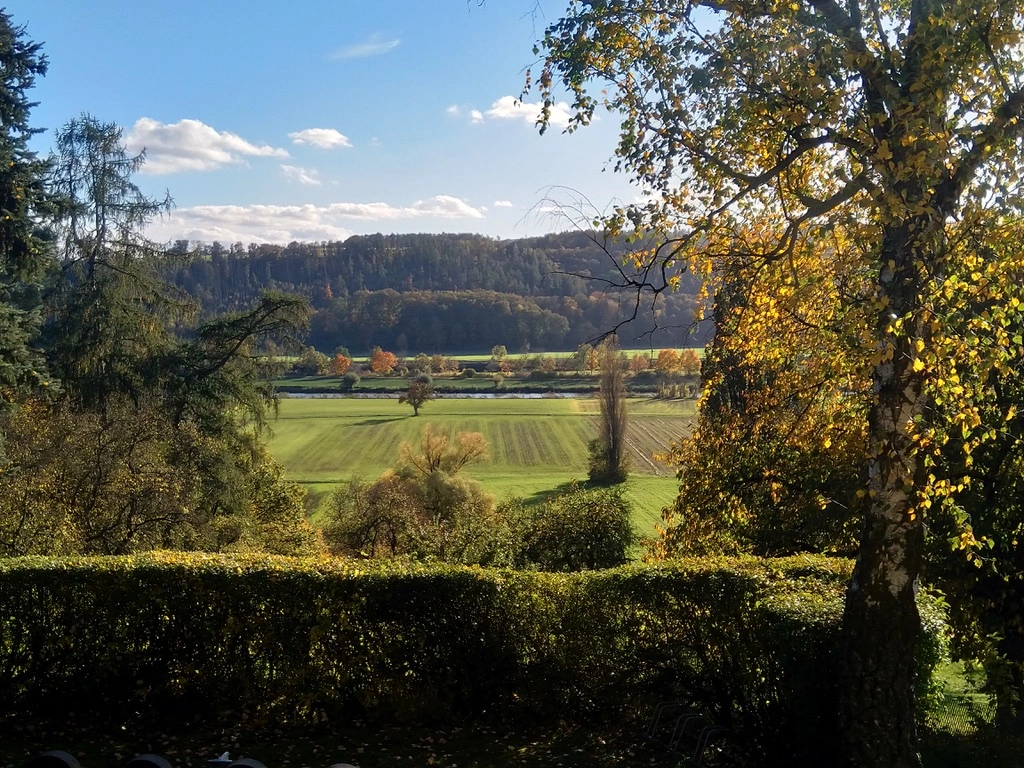
Outlook from the Wilhelmshöhe Tavern, over the Werra River valley, upstream from Bad Sooden-Allendorf, 22 October 2024
TALES FOR TRAIN AND PLANE: TROUBLESOME PLACES
STEFAN IN THE SOUTH SEAS
Stefan is a fifty year old accountant in a sizable German firm. He has been saving to fulfil his dream of sailing to the South Seas and living there for the rest of his life with his partner Marion. They make their preparations and Stefan makes his announcements and farewells to his friends, with various views of the venture emerging. Once ensconced in Tahiti, chartering their yacht to tourists to make a living, they find there is more down than up in paradise. With outgoings outstripping income and eroding savings, Stefan's dream turns sour. After ten years away they sell their yacht and return to Germany. Stefan finds life back in Germany hard to get used to. His qualifications and experience now ten years out of date, he has no luck finding a job. He spends much of his time chasing bargains in the supermarkets to eke out his dole payments. His friends are shocked at his plight and misunderstandings arise. Marion helps him begin to see where he has gone wrong. About 15,000 words. Written 2009.
ONE NIGHT IN BIELEFELD
Mark accompanies Helen on a trip to Detmold, a north German town with a British Army base she lived on as a little girl. She is curious to see the country she knew as a girl but now has little memory of. They end up spending the night in Bielefeld, a provincial city, on the way. Since the youth hostel is closed for Christmas and Mark has little money, they decide to wait the night at the station for their next train the following morning. Hans, a local, sees them and persuades them to come with him to a night club to while away the time. In the course of the night Hans becomes besotted with Helen and makes plans to live with her in Australia. Since neither speaks each other’s language, Mark has to interpret for them, and is amazed that Helen goes along with Hans’s sudden infatuation. Unwillingly Mark becomes a bemused bystander in a night-long romance that seems to offer Hans the prospect of a new life. However at dawn Helen changes her mind. About 10,000 words. Written 2012.
LAKE AIR DREAMING
Ian, a professional photographer, heads off to his favorite salt lake to try to get a magic shot to suit the global advertising campaign of Infiniti, a major Russian vodka company. He has the usual difficulty getting exactly what he needs – the exceptional is not the normal out in the sunblasted desert. With nature refusing to oblige him, his patience and resilience are tried, particularly since his wife, his agent and his friend all have different views about the wisdom of his enterprise. Under deadline pressure from the upcoming Superbowl, he waits till a hurricane is upon him to get the shot he wants – but the nature he needs to make his living is also the nature that endangers his life. About 16,000 words. Written 2013.
WELLS IN THE DESERT
In the middle of the desert a farmer digs wells for bore water to irrigate fodder crops to feed a herd of dairy cattle - and the town of Stuart Springs gets a taste of fresh milk for the first time. At first the farm goes well - it rains anyway and the dairy herd thrives. The government minister gets enthusiastic and appears to back the scheme ‘to green the desert’. But when a long drought starts the wells dry up, the farmer goes broke and the minister loses interest. The farmer asks for the compensation he thought the minister would give him in the event of failure, but the minister refuses to help out. To the realities of financial hardship and a worthless farm are added disillusionment and disappointment. What then becomes of the farmer and his family? About 15,000 words. Written 2011.
THE YEARS BETWEEN
A middle-aged man recalls a childhood love that could’ve made a great difference to his life, had it not been cut short in tragic circumstances. About 3,600 words. Written 2011.
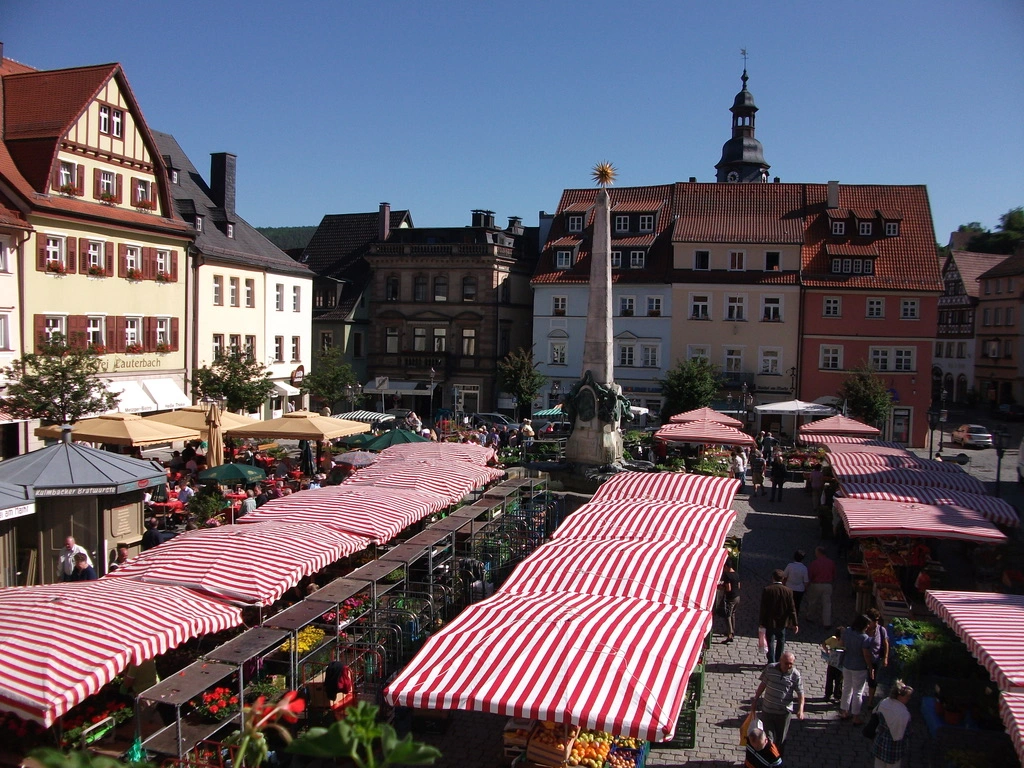
Kulmbach Saturday market, 5 June 2010
LUCKY BOY AND OTHER TALES
12 short stories - 2022 - 2025
BLOOD & WATER Tells of the friendship between Martin, a Sydney secondhand bookseller, and Charlie, one of his customers, from Charlie’s viewpoint. Charlie is an old retired lawyer who has little to do and enjoys hanging round the bookshop, chatting to Martin while Martin deals with customers. They are of different generations: Charlie served during the war and has a melancholy disposition, Martin is a generation younger and much more cheerful (which is one of his attractions for Charlie). Their life experiences are quite different, and in some respects so are their attitudes. Charlie gives a fair account of how they negotiate the difficulties and rewards of such an unlikely friendship.
TO RING OR NOT TO RING Tom, an old friend who lives and works as a lawyer in London rings me and leaves a message, wanting to talk about the COVID-19 pandemic. It’s the first time in a decade that he has bothered to ring me. At least it’s a sign that he is still alive. I hesitate to ring him back. I begin to wonder if I should, as old resentments arise unbidden from distant memories.
BETWEEN REHEARSALS An amusing romp through the different attitudes to their craft of writer, director and actors in the poor-fessional world of independent theater.
ROSANNA ROSA A mutual attraction between uni students Russell and Rosanna, a punk who paradoxically sang early music, didn’t get acted upon, for reasons she didn’t convey to him. Later in life the memory of this unfulfilled potential still rankled and intrigued him, so he looked her up. Like his initial attempts at courtship at uni, his internet search wasn’t straightforward, not least because Rosanna had become Rosa during her brief singing career, and her married name had replaced her maiden name. Once contact was made however it was welcome. Life had imparted lessons and fresh perspectives on possibilities that youth had spurned. The youthful potential squandered was joyously fulfilled – the long dormant attraction vindicated in the end.
STENTS A factual if jaundiced account of a heart attack, a hospital stay and operation, and the aftermath. The account tells much about what it’s like to deal with hospital: doctors, nurses, and other patients, as well as your own ever-changing mental states. ‘Bedside manner’ comes in many colors in big busy hospitals, particularly during the COVID-19 pandemic.
LUCKY BOY tells of a man's relationship with his grandparents, and the influence they had on his childhood. Tellingly, his grandfather also introduced him to the world of music and poetry. The man greatly admires his grandparents' love for each other, and compares his own loves with theirs, finding that for the most part his fall short. A tale of contrast between the emotional styles of different generations.
AN UNPLANNED TRIP deals with Benno's trip to Hamburg to convince his partner Ingrid's siblings that he and Ingrid should move in with their mother Ulrike to ease her slide into senile dementia. Ingrid's siblings would rather that Ulrike move into assisted living care so they can sell the family house and get their hands on the family loot. An exploration of the tensions within a family brought to the surface by parental decline and greed.
WHAT ABOUT YOUR DOG? Nick is thinking about Margy, a girl he didn't know well in Grade 4 at primary school. He used to come second to her in school sprints, so, without them being friends, he thought she was pretty special. On their last day at primary school, before he went off to a Jesuit boys' school for the next eight years, while all his classmates were saying goodbye to each other he suddenly realised he had an affinity with Margy that left him feeling sad and cheated by their separation into single sex schools. Over his life he'd sometimes recall her and this stillborn affinity. Forty years later he decided to look her up. The tale tells of what happens next. And yes, at a crucial stage he does ask her, 'What about your dog?' You'll have to read it to find out why.
FLY During a coffee reverie plagued by an annoying fly, a midde-aged man recalls a couple of his colleagues from his days as a university tutor. As a young woman Sandra was continually infatuated with and then disappointed by young men, who were put off by her excessive neediness. Mark wondered what had happened to her, and looked her up.
SUFFICIENT UNTO THE DAY Frank attends his cousin Tom’s funeral and finds it a bit odd. Later, he asks his aunt why. He gets the shock of his life.
ONE NIGHT IN BIELEFELD Mark accompanies Helen on a trip to Detmold, a north German town with a British Army base she lived on as a little girl. On the way they spend the night in Bielefeld. They encounter a stranger who whiles away the night with them in late night clubs. Unwillingly Mark becomes a bemused bystander in a night-long romance that ends in anger and silence.
HASH A troublesome score in Amsterdam in 1978.
A NOTE ON SPELLING I have adopted a number of mild spelling reforms/standardisations, most of which were once proposed by the Macquarie Dictionary, as a compromise between my own keenness for greater spelling reform and the need not to be so outlandish as to be distracting. 276 pages 86,000 words
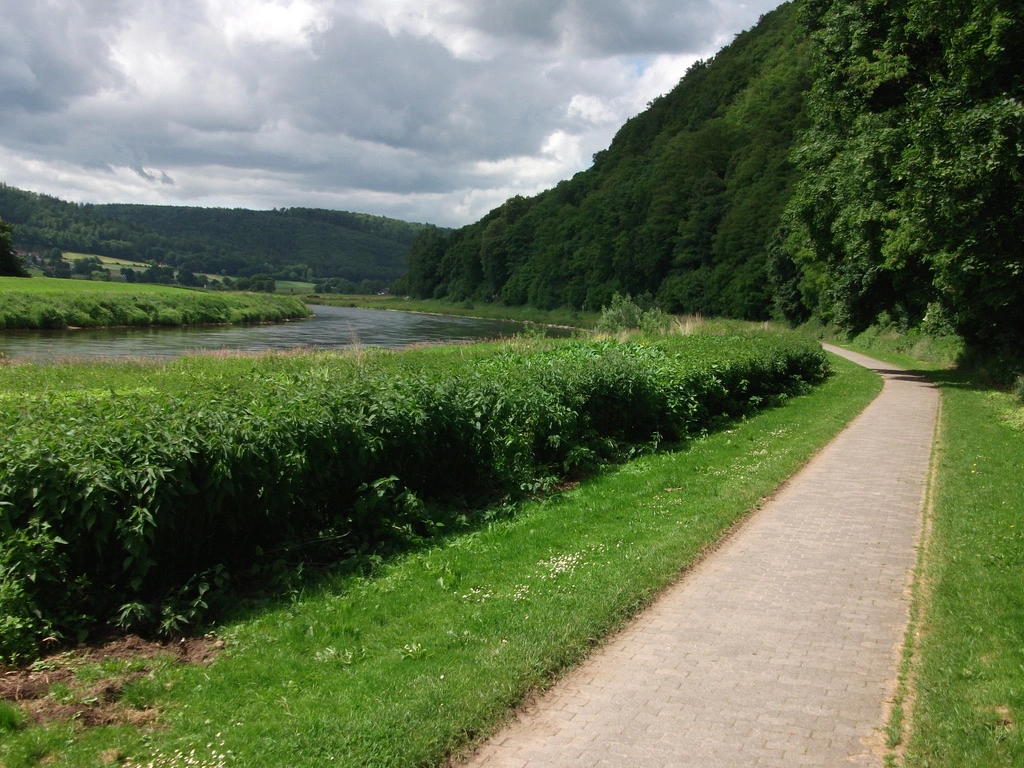
Weser River and bikepath by Bodenfelde, 8 June 2012
SEVEN STORIES
This is a sampler of my work - stories from a couple of my novels, and several stand-alone stories. This also has my thoughts on spelling, which may enlighten or irritate you, depending on your disposition.
THE BOY FROM BLANKENESE
ELISABETH
REICHHOLDSMÜHLE
BETWEEN REHEARSALS
FLY
THE TRAVAILS OF A POST-STRUCTURALIST POST-HUMORIST SCHOOLMARM
SUFFICIENT UNTO THE DAY
A NOTE ON SPELLING
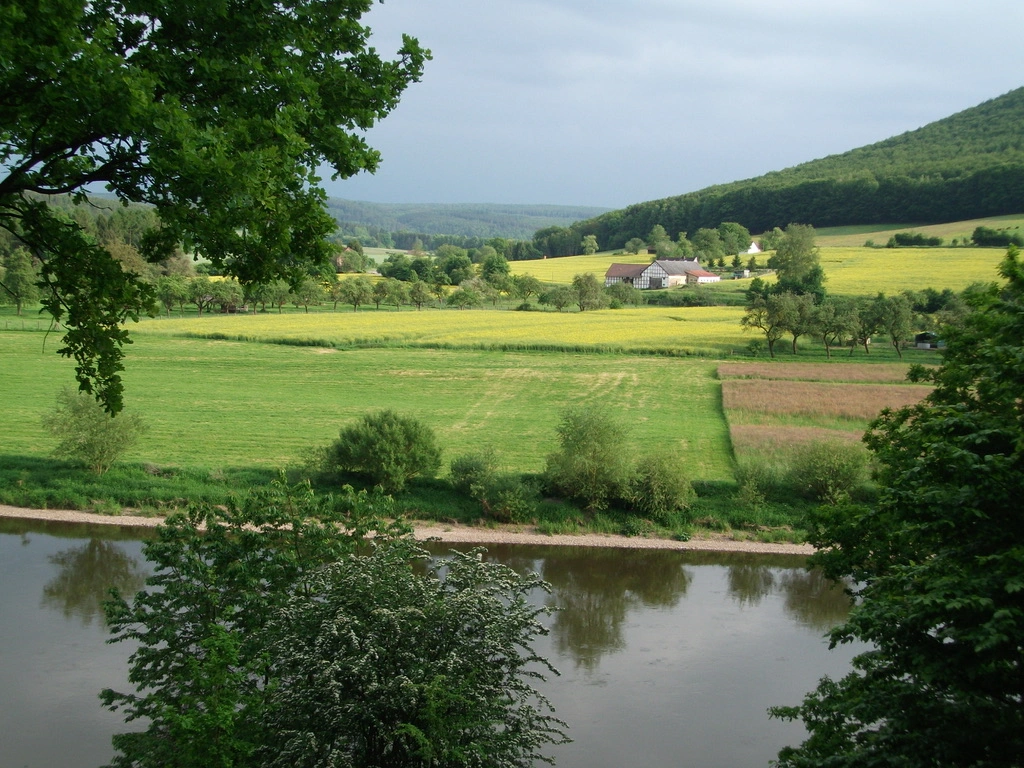
Weser River by Bad Karlshafen, 24 May 2015
POETRY
ON THE RIVER BIKEPATH - POEMS -
gathers my poems from 54 years 241 pages
IN A RIVERSIDE PUB - SELECTED POEMS - a selection from the full collection
174 pages
TRANSLATIONS - all done in 2026
REWRITING HÖLDERLIN - 73 poems translated by Michael Healy - with commentary 243 pages
BEYOND HÖLDERLIN - with no commentary, but with an afterword - 197 pages
HÖLDERLIN PURE - without commentary or foreword / afterword - 191 pages
RILKE - THE DUINO ELEGIES - translated by Michael Healy, with notes - 95 pages
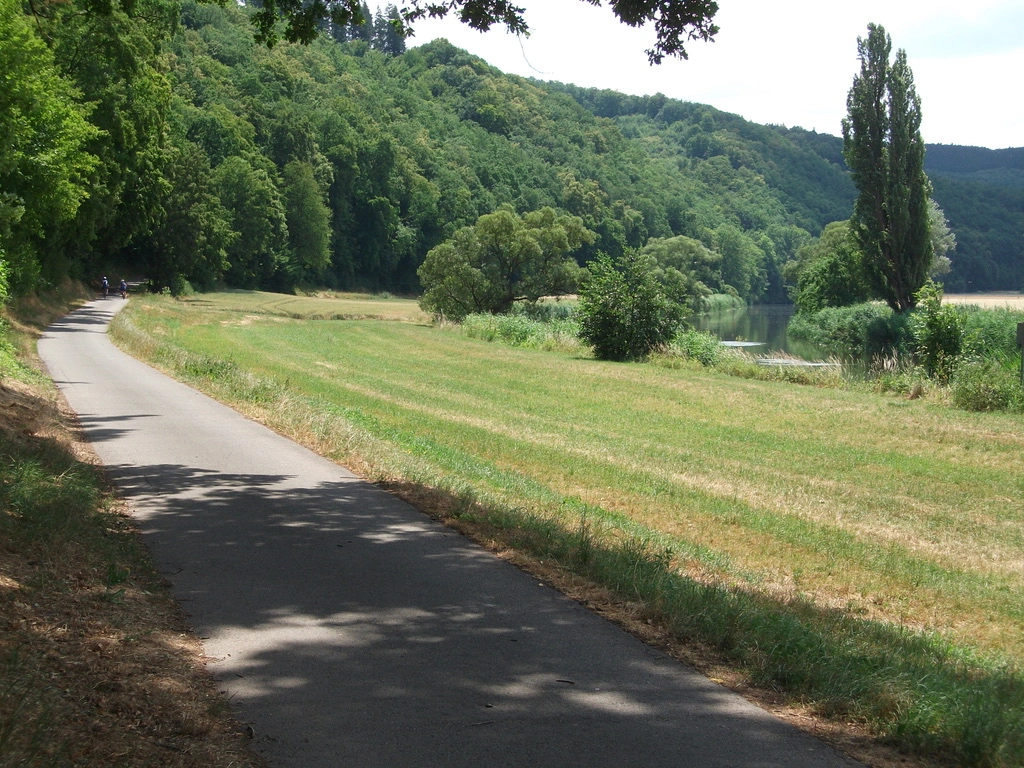
Werra upstream from Bad Sooden, 28 June 2018
BOOKS ON GERMANY
AMONG THE GERMANS - a book about my travels in Germany in June 2018, with some regard for my 40 years of engagement with land and people. A mix of travelog, reminiscence, observation and rumination - with a good dash of grumpiness. Ends with some thoughts about the relationship between Nazism and present-day German behavior. 190 pages, 64,000 words.
THE END OF WHISTLING - TELLING DEUTSCHLAND 1977-79 An account of my three years in Göttingen and travels around Germany in those years. 428 pages, 129,000 words
COLD WAR CONTEMPLATIONS - BERLIN 1985 & STITCHING THE WOUND Observations from a month spent in Cold War Berlin, coupled with an account of my bike trip thru the former East Germany in 1990, just after the Berlin Wall came down. Stories from before and after the fall of the Wall. 114pages, 35,000 words.
AMONG THE GERMANS - shorter version & STITCHING THE WOUND 177 pages, 61,000 words.
ASPARAGUS WEEKS - the 2023 Bad Karlshafen tripalog pic and commentary - PDF file.
DEUTSCHLAND IM HERBST - NOTES FROM OCTOBER 2024 - a pic and commentary tripalog - PDF file.
FRISCHER SPARGEL - BAD KARLSHAFEN, JUNE 2025 - a pic and commentary tripalog - PDF file.
8 TRAVEL PDFs of my German trips - fotos with commentary:
2008 - Lahn, Nahe & Neckar rivers, and Berlin - May-June 2008
2010 - Mosel, Saar, Main & Tauber rivers - May-June 2010
2012 - with Roger, Werra & Weser rivers, Kochel am See, Eberbach/Odenwald, Rhein - June 2012
2015 - Bad Soden-Salmünster, Bad Mergentheim, Bad Nauheim, Bad Karlshafen - Kinzig, Tauber & Weser rivers - before Karen & my Italy sojourn - May-June 2015
2018 - fotos and commentary to accompany AMONG THE GERMANS - Bad Neuenahr, Mainz, Rheinland, Worms, Bad Bergzabern, Wissembourg (Alsace), Speyer, Göttingen, Bad Karlshafen, Bodenwerder, Bad Pyrmont, BK, Goslar, Bad Harzburg, Bad Sooden-Allendorf, Frankfurt - June 2018
2023 - SPARGEL WOCHEN - a month in Bad Karlshafen - June 2023
2024 - DEUTSCHLAND IM HERBST - Bad Neuenahr, Bad Mergentheim, Bad Sooden & Bad Karlshafen - October 2024
2025 - FRISCHER SPARGEL - a fortnight in Bad Karlshafen - June 2025
Available as PDFs for the asking by email.
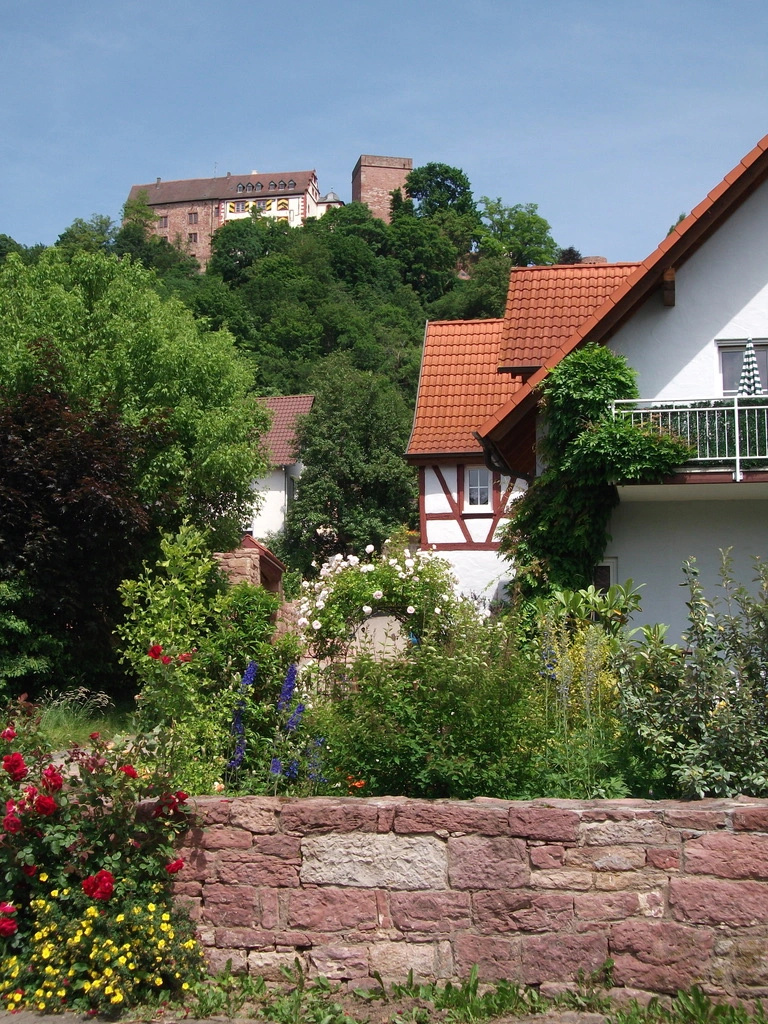
Gamburg, Tauber River valley, 16 June 2010
DERISION - a series of dialogs arising from our time
Fiona, a nurse, and Sam, a bookseller, live together for many years as a happily companionable sexless couple. Fiona has a typical nurse's black sense of humor. After many years her back starts giving her so much pain she has to stop nursing. She goes back to university and becomes a school teacher. At uni she struggles to come to terms with the fashionable French Post-Structuralist thinking that has become the new orthodoxy in the Humanities. Between this thinking and the need for her to be exemplary in front of her school classes, she loses her nurse's black sense of humor and becomes a different person - one who Sam can no longer happily live with. Done in a series of dialogs, interspersed with an 'ethoser' who declaims several representative passages from Derrida, Foucault, Barthes and Leavis, DERISION shows how present-day identity politics and 'politically correct' intransigence and intolerance have come to divide us in ways that used not be possible when we were more aware of what we had in common than what we didn't. Insisting on 'difference' - a favourite buzzword of the French Post-Structuralists - has come to fragment us, setting us at odds with each other, sometimes with violent and deplorable consequences. 103 pages 25,000 words
As of September 2026 DERISION now includes
GERMAN THINKING AND HOW IT HAS INFECTED THE WORLD FOR THE WORSE
Buried in my works are passages that highlight the harm that German poets and philosophers have wrought upon the nations and peoples of the earth. This is a gathering of those passages, so you don't have to wade through my fiction and non-fiction to find them. I'm doing this because most people have no idea of the harm that German thinkers have caused... or they do realise this, as per Nazism and communism, but they don't realise where it comes from. People need to understand where this harmful thinking comes from, and realise the extent of its embedding in our customary ways of thinking, to our detriment.
The book is now 152 pages and 39,000 words.
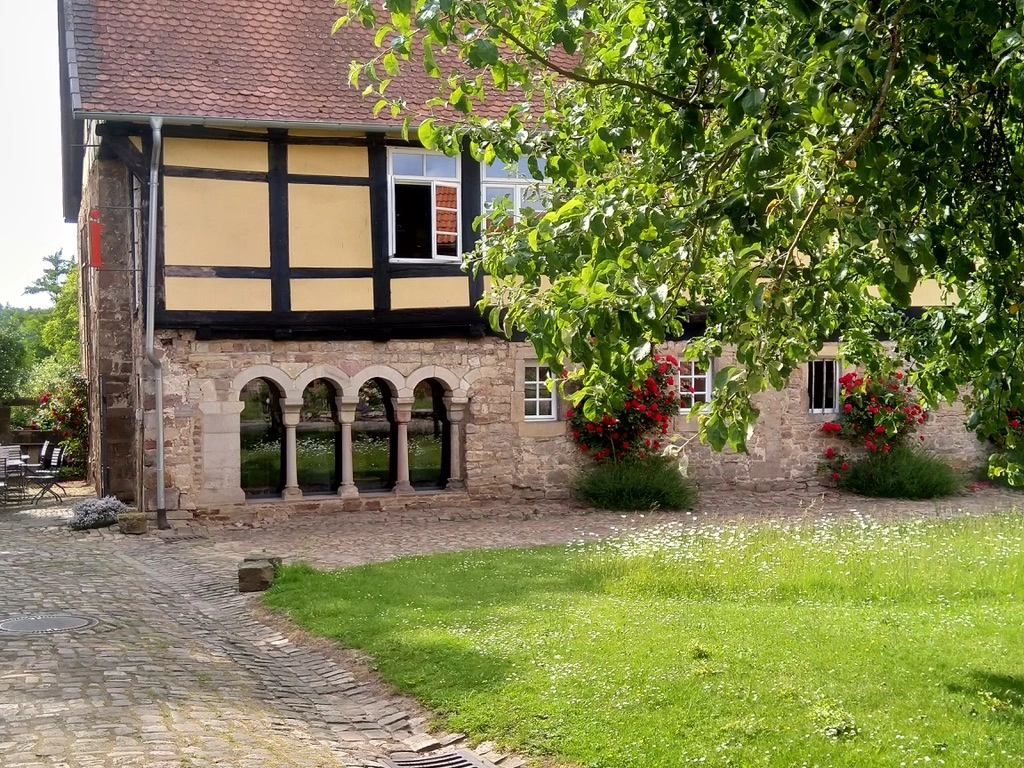
Kloster Lippoldsberg, Weserbergland. Unusual romanesk base beneath half-timber upper. 4 June 2025
PREVIOUS PUBLICATIONS
Apart from self-publishing on Amazon I had a number of pieces published in the 1980s and 1990s in magazines such as Meanjin, Arena, Quadrant and the Melbourne Journal of Politics.
STITCHING THE WOUND - Travels in the New Germany - Quadrant, June 1991
BERLIN HERE & THERE - Meanjin, 2/1990
THE REDNESS OF TOMATOES - Arena 77, 1986
WHERE DOES THE MUSIC GO WHEN IT'S OVER - Melbourne Journal of Politics 17, 1985/86
DOMINION ECONOMIA - with Nikos Papastergiadis - Melbourne Journal of Politics 17, 1985/86
EROS NOW - Meanjin, 3/1984
I also won the Melbourne University Student Union Writing Prize in 1980 and 1981 for different versions of Berlin: Here & There, which ended up being published in Meanjin in 1990.
I also won the 1985 Felix Meyer Travelling Scholarship for a Writer, awarded by Melbourne University.
Since then I have preferred to write novels, plays, German memoirs and travelogs. Five of my 14 plays have been produced in Melbourne – two at La Mama, one at Northcote Town Hall, one at Club Voltaire and one at The Butterfly Club.
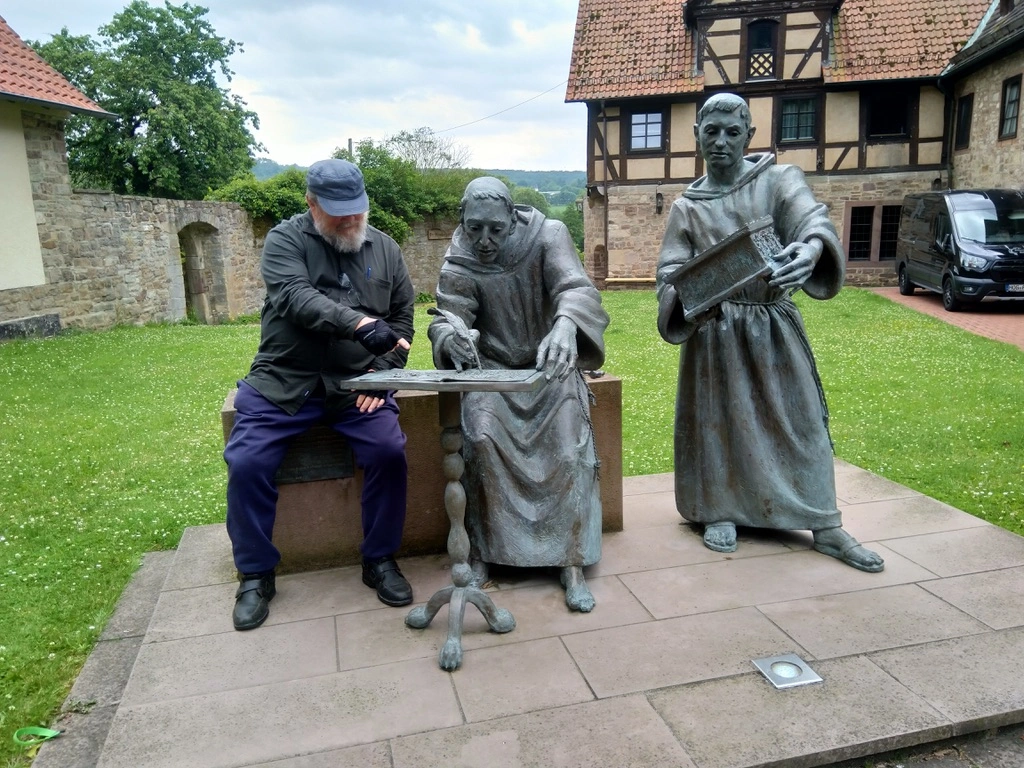
Helmarshausen Abbey sculpture, 10 June 2025. Me pointing out a slip of the pen in the monk's manuscript. (Helmarshausen is a village neighboring Bad Karlshafen and now incorporated into it, in the Weserbergland.)
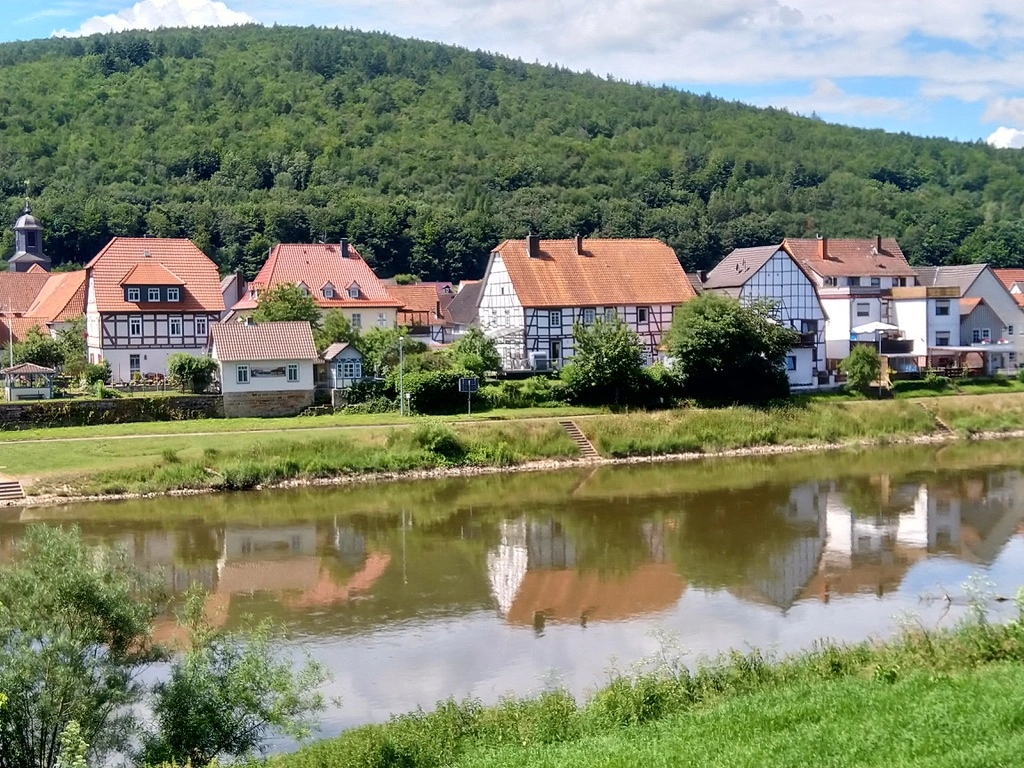
Gieselwerder, Weser River, 28 June 2023
LIST OF MY BOOK COVER FOTOS
CICADA Green Grocer Cicada
FRIEDA Berlin Charlottenburg - Schlüterstrasse 53
GREEN WOLF Nieme River- tributary of the Weser, Bursfelde
OUTLAW Fritschestrasse - Berlin Charlottenburg
FLIGHT Singapore Airlines plane, Changi
TALES... PEOPLE DB train, Miltenberg
TALES... PLACES DB train, Bad Soden-Salmünster
BAD SOODEN Werra River, by Bad Sooden-Allendorf
I SET OFF AT TEN Weser River, Bodenfelde
REDMOND STREET 15-21 Grattan Street, Carlton
AMONG THE GERMANS Wehrden Fährklause, Weser River
BY DINT OF GRACE 153 Barry Street, Carlton
LUCKY BOY & OTHER TALES White cedar bloom, 8 Streeton Court, Mont Albert (melia azedarach)
SGIAN DUBH Scottish dirk
AMONG THE GERMANS - SHORTER Wehrden Fährklause, Weser River
DERISION Tutorial room, John Medley Building, Melbourne University
THE RIVER BIKEPATH Werra River near Lindewerra
IN A RIVERSIDE PUB Zum Weserdampfschiff terrace, Bad Karlshafen
SEVEN STORIES Blankenese, Hamburg, Elbe River lighthouse
GREEN WOLF PLAYS Isar River, Bad Tölz
TWO TALES Melbourne University, steps between Baillieu Library and the South Lawn
THE END OF WHISTLING The Wahmbeck house that saved me from hunger knock and gave me directions when I got lost on a ride to the Weser River from Göttingen, summer 1977
COLD WAR CONTEMPLATIONS - BERLIN 1985 Cafe Avril, Graefestrasse corner Böckhstrasse, Berlin Kreuzberg
REWRITING HÖLDERLIN Hölderlin Tower, Neckar River, Tübingen
BEYOND HÖLDERLIN Hölderlin Tower, Neckar River, Tübingen
HÖLDERLIN PURE Hölderlin statue, riverside park, Nürtingen
RILKE - THE DUINO ELEGIES Duino Castle, Italy, near Trieste
NB: there's more than one Michael Healy up on amazon, so be careful! This Michael Healy has not written 'Pubs of Ireland', 'Ireland Mosaic' or 'Day of the Mermaid and Other Poems'. Nor should I be confused with michaelhealy.com, a Rhode Island maker of bespoke brass doorknockers, some of which are quite marvellous. (Buy a doorknocker from him and a book from me? Ding dong!)
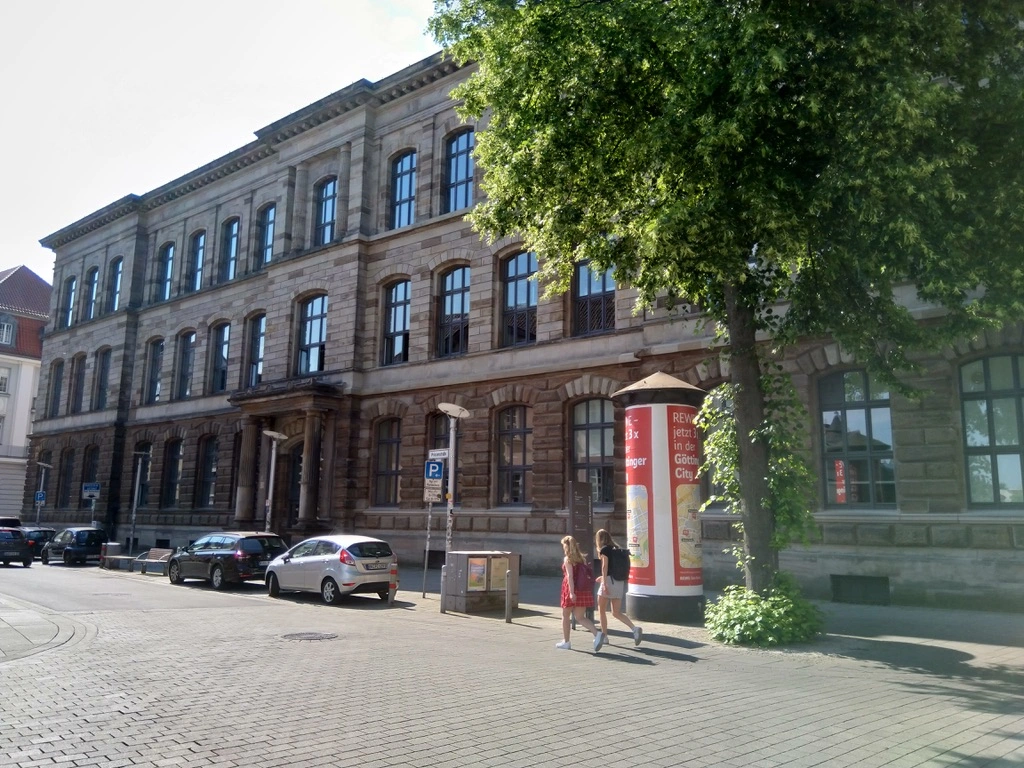
This is where it all began: The Niedersächsisches Staats- und Universitätsbibliothek (the Lower Saxony State and University Library), Göttingen, 24 July 1978.
After a day trip by train to Fulda and back, I popped into the library, full of the fresh realisation that I was a writer, and had been writing since I was 14. My first awareness of my calling came to me in this building, on that afternoon.
It was an epifany. Having had an eventful day, on my way home from the station I popped into the uni library, sat down at a desk, began to write... then realised this is what I always do, and had done since I was a 14 year old, writing little poems, writing down my thoughts...
I write to process experience. It's what I do. It's a habit and a practice, but it's also a gift and a calling, which oblige me to make the most of them.
And from the very start of that realisation it felt like the gift and the calling came from outside me - from something far greater than me.
I won't claim that it was a moment of total clarity, with my whole life laid out before me, my only task being just to 'live it out'.
But it was a moment of first awareness that this was something I had to do... a gift to do justice to and a calling to serve.
At an instinctive level I knew I had to arrange my life around this suddenly realised but long built up to imperative.
And so, whenever in the future I had to make decisions about study, work, jobs, relationships and so on, I felt I had to 'make room' for my writing. It was always a key consideration.
And so all thru my subsequent uni studies and later in my work life, I always made and found time to get on with enuf writing to keep me happy, to get works completed.
I reckon it was mostly 'instinctive', such decision-making, but when I look back I'd have to say it was pretty unerring. I never did anything that stopped me from writing altogether. I cdnt have stood that. I knew that wd make me very unhappy.
I've managed to fulfil my gifts and honor my calling. I have served them as well as I can. That makes me happy.
But I didn't have any choice in the matter. I had to do it. It was my fate. It was a bondage - my happy bondage.
I'm very lucky. Most people don't get that kind of luck.
Not that I 'deserved' my lucky fate. It just came along and told me what to do. That's no great virtue or feat on my part. I just did as I was bid. There's no special merit in being so 'called'. It wasn't about 'me' - and I knew that too, right from the beginning.
That took the pressure off. All I did was do what I had to do. That sounds simple, and maybe it is. But to be able to live your life without feeling the pressure to 'perform'... that's a great blessing.
I was only ever the keyboard to realisation - a means by which...
As an after note: the events of that eventful day 24 July 1978 fed into my novel BAD SOODEN, written in 2015, 37 years later. That's how long the gestation of a novel can be. Writing can and shd be quick, but gestation is long and can't be hastened.
You come to know that your writing works on those two levels, and at those two quite different speeds: the slowness of the gestation, and the quickness of the actual writing... neither of which you can control. You just accept them, as they come, in their own time, and at their own speed.
It's a great joy to be part of such an unfolding.
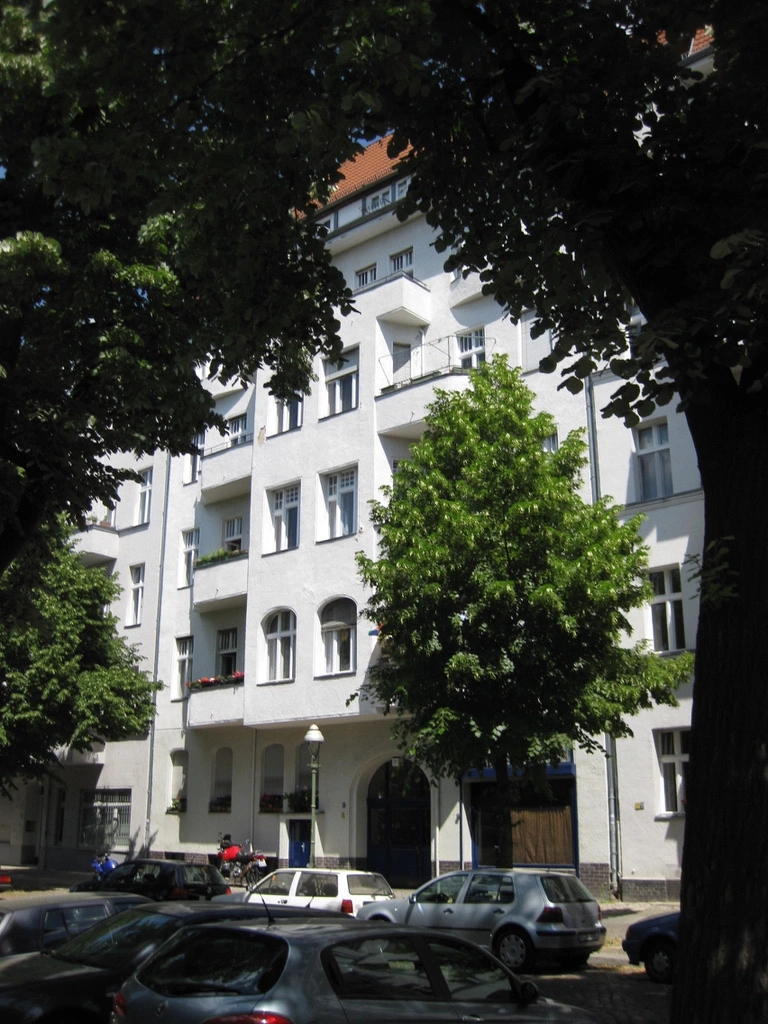
Fritschestrasse 77, Charlottenburg, Berlin, 5 June 2008, where I lived in October 1985
Thoughts on the creative process
with more particular reference to writing and painting/drawing
Drawing, painting and writing are exploratory, heuristic, delving...
... which just means you start from a state of not knowing, which for short can be called ignorance, but that word implies broad unknowing, whereas in art and writing you may know a fair bit but you're intrigued by somebody or something you want to find out more about, which aint the same thing as broad ignorance...
I like to call it a Cloud of Unknowing... a concept, which despite, and because of, its origins in medieval Christian mystical thinking, means a lot to me. It's useful to think of it in secular terms too. It sets the relations between elements in their right constellation or matrix. https://en.wikipedia.org/wiki/The_Cloud_of_Unknowing
Whatever, you're going from a blank sheet to a filled sheet, via a process of exploration, to find out what's there by actually drawing or writing.
That is, you don't, and can't, know beforehand what you're doing, or what it is you're discovering, or indeed where you're going to end up.
Planning pre-empts this process. Planning makes stillbirths of artistic impulses. Okay, you need something to be drawn or painted, or to be written - an idea, a curiosity, a memory, an impulse.
But an impulse is just a starting point. It's never the end point or the last word - or indeed the full picture. Nor is it any sort of plan.
In my case I'd always have one or more people as my starting point, usually a relationship, or at least a desire for one - lives that intrigued me.
People are my starting point - specific people. They may emerge differently, become somebody I don't know, meld and blur with others, become fusions and amalgams, but they start as people I know.
Then the story takes over and demands its own personae and experiences, and so changes 'my people' into sometimes quite unrecognisable 'other people'.
That's the symbol-making function of writing at work. That's the transformation - without which your writing is no better than the baldest newspaper reporting.
My people wd then undergo a crucial event or transformation over time, which wd leave them changed. The story is a recording of this process of finding out. Even if it amounts to nothing in the end, and the mystery remains unsolved, at least you've explored the scope and the possibilities.
And sometimes people can go thru momentous change but end up 'the same' as they were - the same but different, so to speak.
All my stuff, fictional or factual, is told from a first person participant point of view. 'I' is the storyteller, who is also one of the main characters in the story. This means that the reader finds things out at the same time the storyteller does.
As the storyteller is also one of the main characters, their interest in the story drives it along. It gives the story urgency and drama. The storyteller has a personal stake in the story. This is something an omniscient non-participatory third person narrater cannot match for involvement and engagement.
In short, the storyteller was 'there'.
The third person all-knowing narrater is inherently more removed from the story, which lessens its impact in comparison with the first person participant viewpoint.
I read Somerset Maugham on this point, long after I'd found for myself that this approach was what worked best for me. I never felt comfortable with the 'omniscient third person narrative viewpoint' - the 'God perspective' never appealed to me. At first it was an instinct - I don't like playing God, so I never wrote that way.
But then, long after my beginnings, I read Maugham on precisely this, and he crystallised my thinking. The 'I' protagonist viewpoint is the best and most natural way to tell a story. We're hard-wired for it... around the tribal campfire, that's how we tell and hear our stories.
This accords with the exploratory, heuristic aspect of what writing and painting shd be. Stories shd 'unfold', one thing leading to another.
The other beneficial aspect of using this first person viewpoint is that it automatically limits the amount of stuff you can include in a story. The God perspective lets you include all sorts of things that a single protagonist cannot know. You can jump from character to character, giving their viewpoints, experiences and whathaveyou - it can get unwieldy.
The first person perspective forces you to tell everything thru that one person's eyes, and since they can't know everything, you can't include everything. (It actually increases the amount of implicit background stuff the protagonist can't know, but which the reader suspects is there - that guessing is a pleasurable part of reading. The reader imagines what the backstory might be.)
Cos you can't include 'everything that God knows', only what the shitkicker hero-storyteller down on Earth knows, that keeps your stories leaner and more to the point: What don't I know? and, What am I finding out? First person viewpoints almost by definition can't be baggy monsters and dogs breakfasts. It's an inherently more economising discipline.
It also means first person stories have better narrative drive - they get on with the story cos they can't digress into other viewpoints. They are pacier and less cluttered. I like that. It's an instinctive preference.
For example, SGIAN DUBH was an exploration of 'why' a couple of women I knew went thru life without marrying or shacking up with a bloke, which in their cases also meant they never had sex. This intrigued me, and in the book I coalesced the two and let what did or didn't happen to this combined and invented person unfold over a long period of time - a lifetime in fact.
So this is a good example of how I work. I start with people I know, then do a kind of 'what if' scenario, in which I explore what might've happened to them. It's informed by what actually happened, but leaves room for variants and aspects that didn't actually happen, so that I and the reader can see more clearly what's involved and what's at stake. That's what fiction does.
It's also what art, drawings and paintings do. They help us see what's really there, and they also allow elements to be brought together in ways that don't necessarily happen in nature or real life.
There's also this aspect of 'what if' in painting, even the most realistic painting. If the 'what if' isn't there, it's no good, cos otherwise all we're doing is mere likenesses, and shallow appearances. There's no symbolic resonance. It may as well be a fotograf.
What wd this scene be like if we left out this, or included that, and over here, rather than there, enlarged this, foreshortened this, reduced that, sharpened this, blurred that... and so on. The process of sifting and selecting, and eliminating and placing... that's all 'what if' too. Like fiction writing, painting is also subjunctive.
Some people want to know if this or that actually happened in my stories. Fiction is subjunctive - it's about what might have happened.
Fiction allows the undergrowth to be cleared away so you can see the trees and the forest. It's not biografy or autobiografy. All biografy does is record as best can be known what actually happened in someone's life.
And since what can be known about most lives is necessarily incomplete, cos no life is recorded in constant minute detail, there are gaps, which the biografer can't fill. The biografer's jigsaw puzzle always has missing pieces.
The fiction writer can however fill in the gaps with sixty seconds of distance run, thus making a more satisfying story of a life or lives. The fiction writer can fill the gaps with fair speculation and educated guesses.
The curiosities involved in fact or fiction are perhaps similar but they're not the same. Fiction is, if it's any good, always asking the question, what wd it have been like if this had happened to them, or they'd decided to do this instead of that.
Fiction raises questions about possibilities, rather than merely telling you what happened. Biografy can lead to questions too, but what actually happened dominates, and is always limited by what can and can't be known about any given person. With fiction it's more about what might have happened.
Actual depictions of life and things have their place, but so does 'holding things up so we can better see them'... or 'holding up alternative scenarios to see what they look like'. Exploring both can make us wiser. That’s the hope anyway!
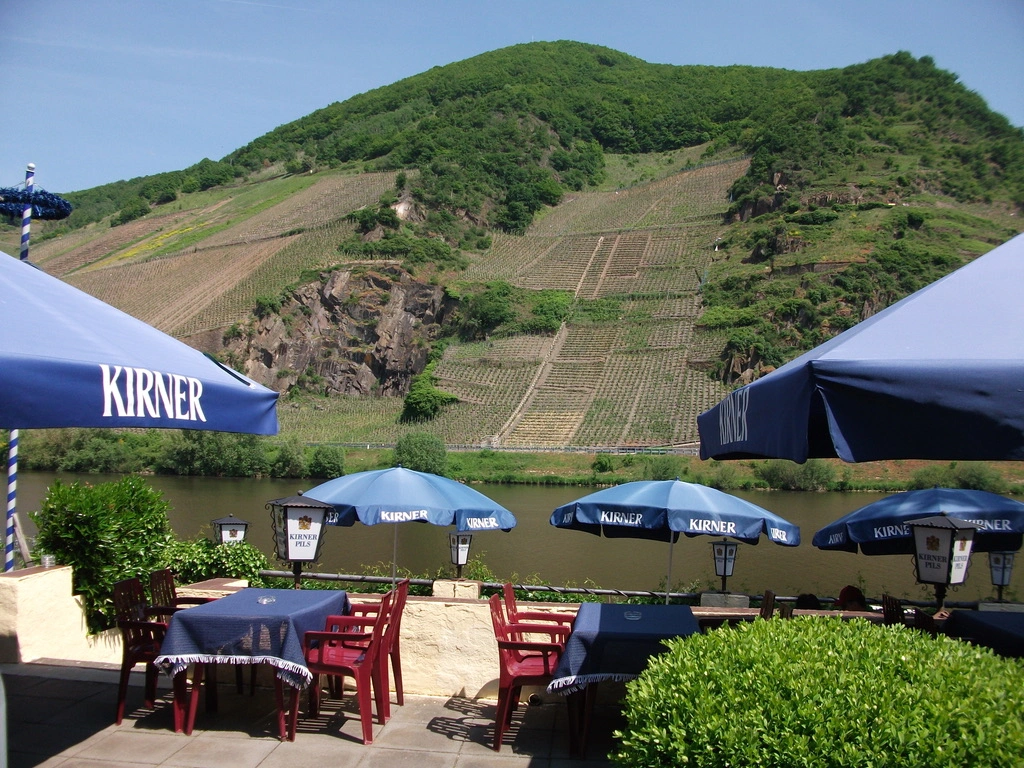
Looking over the Mosel River at the vineyards between the slate outcrops - from the Hotel Deis Biergarten, Senhals
Which gets me back to my point about opinions being provisional, meaning that you can therefore give them your fullest, most vigorous expression and energy, thus saying, and this is the invitation to your interlocutors: Until you say something better, this is what I think, and I have thought about this, so I'm serious, but I am also open to changing my mind if more evidence and/or better arguments emerge. Over to you, chum.
Fiction is a place where I can give expression to attitudes and opinions that I may or may not hold. It's a way of seeing them, to either keep agreeing with them or finding them lacking in some respect or other. A writer who rigidly holds to particular views is usually no good. They are then merely ideological, rather than exploratory.
It's not a writer's place to have rigid opinions or ideologies. It is not a writer's job to be polemical. It is however the writer's job to be a prism, thru which the light passes, revealing the colors of that light.
As David Malouf once said, in his Boyer Lectures, imagination is not fantasy. Fantasy is making stuff up. Imagination is finding out what's really there. Imagination requires breadth of knowledge and empathy, so you can be both across a wide range of facts and also have an understanding of what makes people tick... facts and behavior.
On the face of it, this sounds counter-intuitive, but Malouf is right. Imagination is about really looking hard to see what's there, seeing beneath the surface, delving into what's hidden.
Fiction and drama are where you can let these things, these 'facts and behaviors', play out, so we can see them better.
Planning everything in advance means you can't let your characters or what happens to them change, evolve, become something that surprises you and therefore the reader. If all you're doing is joining up existing dots, ticking off your list of planning points as you go along, you're not allowing your characters room to breathe, and change, thus surprising you - and your readers.
If you keep your forms and processes open-ended, what you write can go off in different directions, to places you never even knew were there. Don't close off possibilities before you even start.
Stories and characters shd 'unfold'... naturally, in their own time and way... without having their own logics and rhythms and waywardnesses and unexpected aspects and digressions 'trimmed off' cos they don't fit 'the plan'. Stories shd be free to be whatever they are, not what the writer of limited imagination thinks they shd be.
Any writer who thinks they are 'in control' of a story is kidding themselves. You're riding a bucking bronco, not sitting calmly on a tired old draft horse with three hooves already in the knackery.
For me, the greatest thrills I got from writing were writing a passage, not knowing where it wd take me, but once I'd got there, I'd look back and think, Fark! So that's where this was headed! It's the greatest string of thrills I've ever got from doing anything. If that keeps happening, each new section ending in complete surprise, it's just bliss. And when that was happening for me, night after night, I knew I'd been the conduit for something marvellous.
I write to delve, to find out what's there, as I'm going along. I do not know beforehand where I'm going. I'm just a conduit, taking dictation from God.
And if that stops you in your secular tracks, I'd just say this: I don't 'believe' in God, any more than the average modern person does in the now secular West. But 'God' is a word for what's outside us and greater than ourselves, and conveys a sense of 'source'. It's shorthand, and it's just a word, and if we have the word for something it does exist, irrespective of whether we 'believe' or not... the word does not need our blessing or withholding of blessing... if the word is, then the thing exists... it really is that simple... it's a fact of language... and if that makes 'God' just a figure of speech then so be it, it's pointless to deny it...
... but I as a non-believer have no problem at all in saying that when I'm writing I am taking dictation from God. That paradox is part of the richness of life. Any writer or artist who has no sense of being in the service of something larger and greater than and outside themselves isn't doing anything worthwhile. To call it God is a useful shorthand way of naming this fenomenon. In that sense it never has anything to do with 'me'.
When you're writing or painting there is no ego - at the point of the pencil or brush, or at the point of the pen or the fingertips on the keyboard, there is no ego. You are just the conduit, the means by which something wondrous comes into being.
(Before and after you can be as egotistical as you like - sink a ton of piss, fuck forty whores in a fortnight like Georges Simenon used to after he'd written a book in a white-hot fortnight, before collapsing for another fortnight of nothing but bedrest - that doesn't matter. But while you're working you don't matter a jot. If you think you do then you're not a writer's or an artist's bootlace. IT'S NOT ABOUT YOU.)
Another thing that preempts and closes off possibilities, is too much education and theory. It's good to know something, but it's not good to let that knowledge and theoretical framework imprison you, straitjacket your potential, truss up your stories or paintings in a cocoon of conventional expectations. Otherwise you just write, or paint, to a formula, some pre-existing set of possibilities, which mean that you already know what you're going to find out, cos you've already decided what you think before you've gone anywhere.
Which is why too much education, and in particular too much theory is a bad thing. It stunts your growth, cos it doesn't let new discoveries come into your work. Theory-driven art already knows what it's doing. I never know what I'm doing till I've finished and can then, WITH HINDSIGHT, see what it is that I’ve done... and even then I won't see it all... you never see it all...
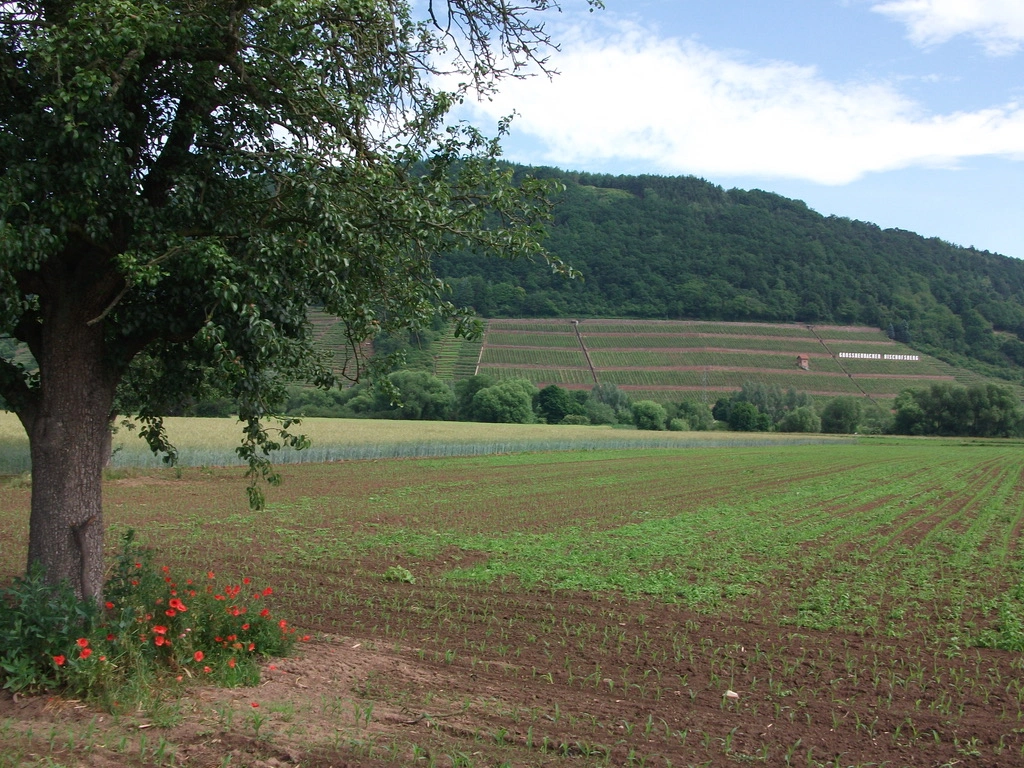
Main River valley poppies, old apple tree, crops, riverbank trees, vineyards & woods, across to Grossheubach Bischofsberg, 18 June 2010
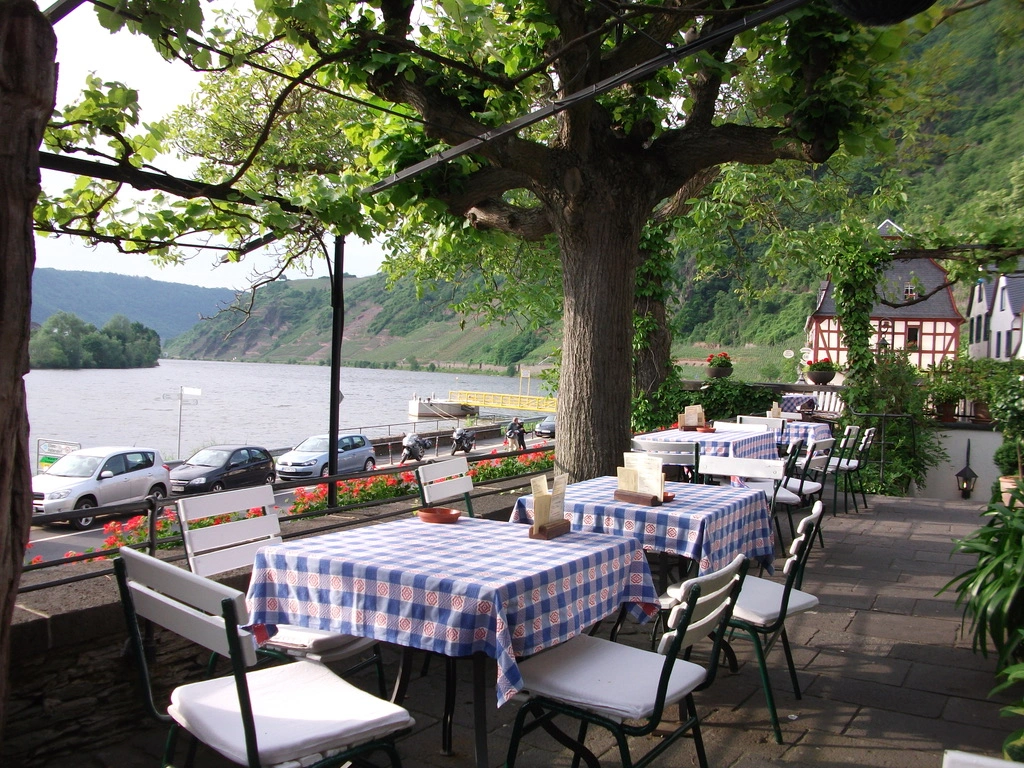
Haus Lippmann Terrasse, Beilstein, Mosel, 3 June 2010
Kafka said his pen was his organ of perception. A painter's pencil or paintbrush is theirs. Now for me my pen of 50 years ago has become my keyboard, but I always start off in a Cloud of Unknowing, wanting to find out what's there.
(A propos, I actually took to the keyboard like a bird to air. I cd type so much quicker than my fountain pen or biro cd write. The keyboard let me fly faster, and when you're hot you're hot - you really need to get it down as fast as you can, cos the threads can vanish as fast as they occur. Speed is of the essence. Slow coaches don't get it done when the whips of story are cracking. The keyboard widened the conduit. The landline became broadband.)
That's all a writer or a painter ever does - find out what's there, or at least try to look for it. They explore and delve. And you can only do that by actually writing or painting. You must 'set out'. You surprise yourself as the ink or paint is drying, in the act itself. Until you're actually doing it you can't know where you're going. You find that out IN THE WRITING, or IN THE PAINTING - IN THE DOING.
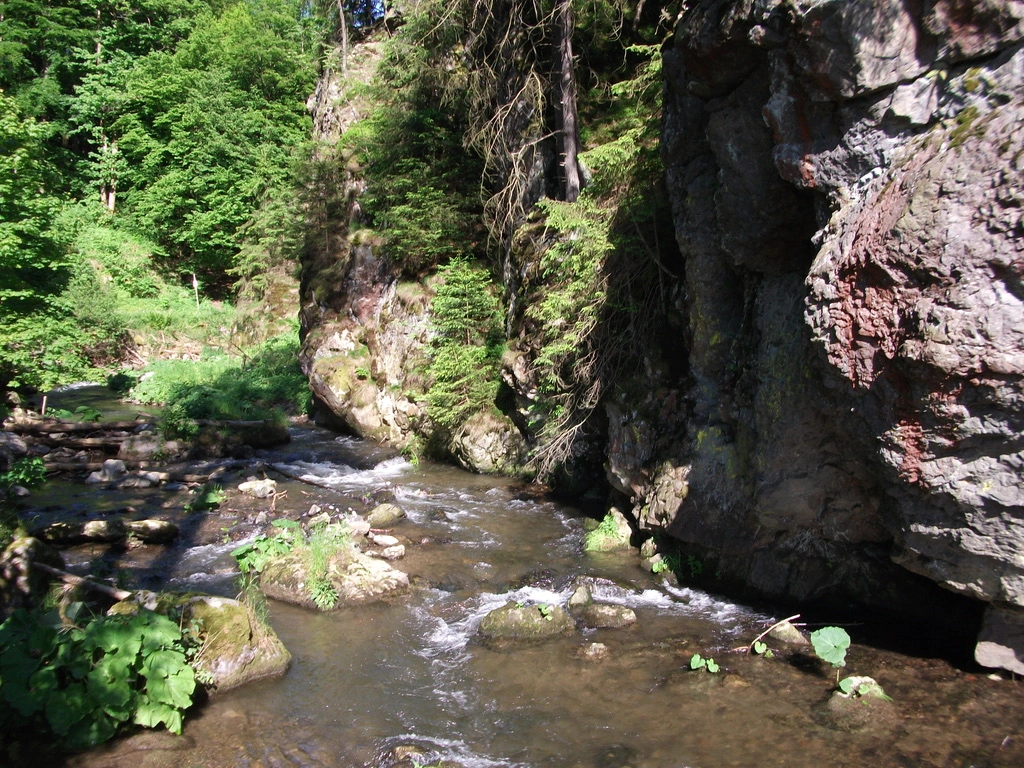
Steinach gorge - the Steinach is a northern tributary of the Main River near Kulmbach, 6 June 2010
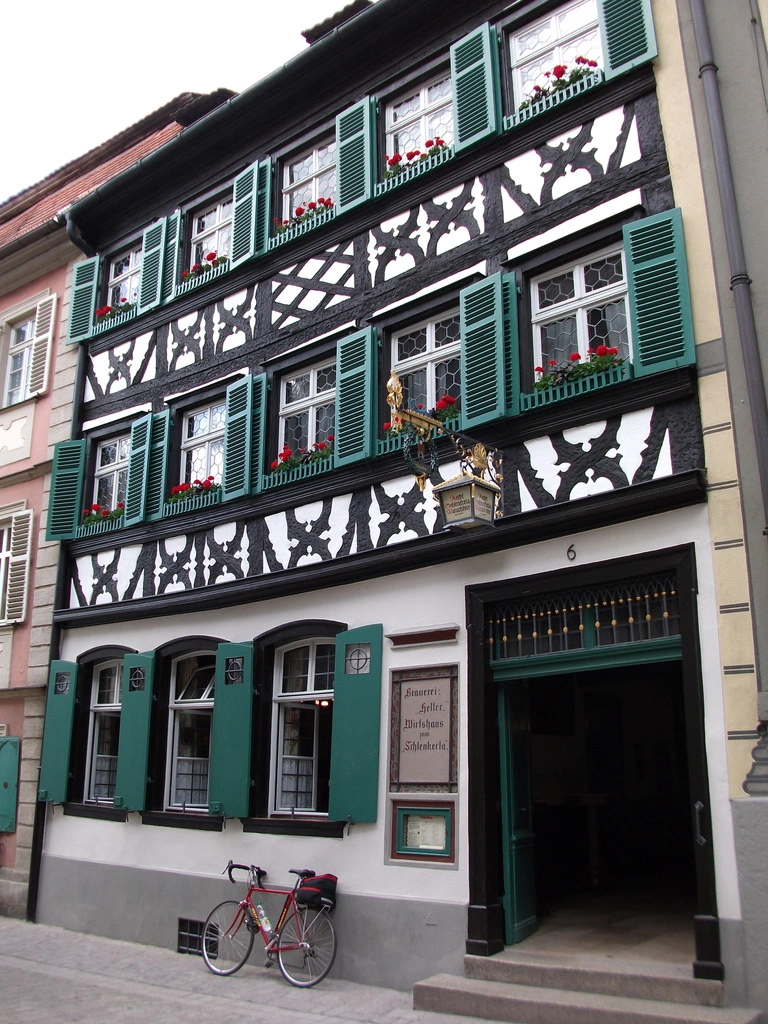
Bamberg, Main River, Schlenkerla pub, famous for its smoked beer, 7 June 2010
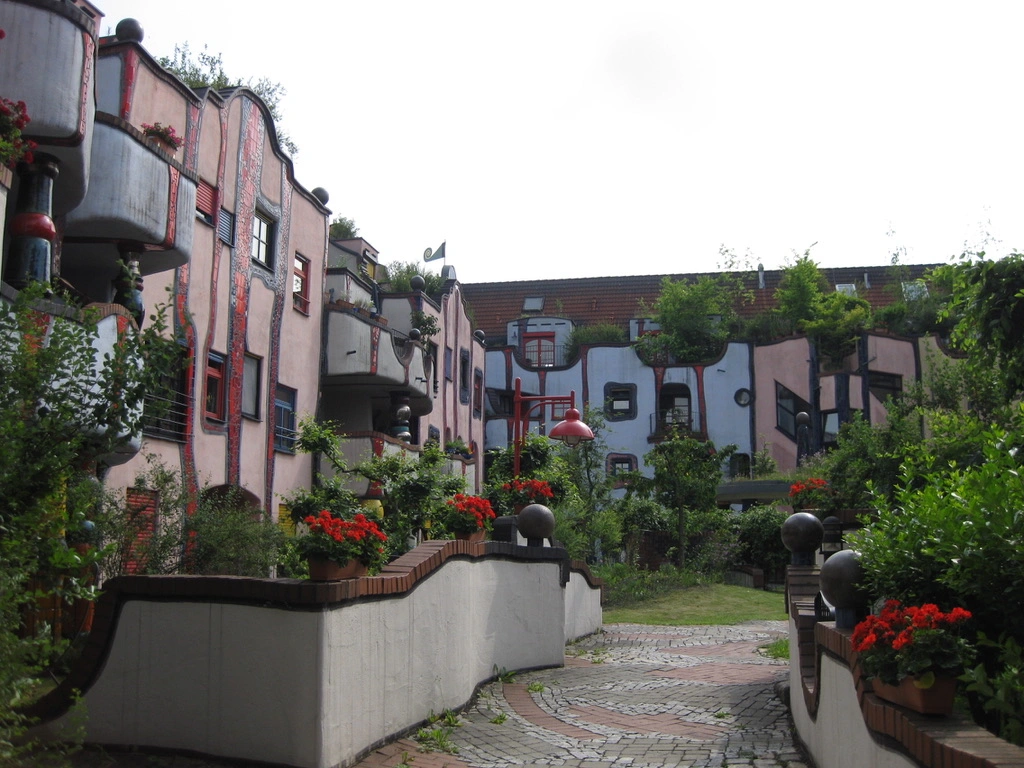
Plochingen, Neckar River, Hundertwasser block of flats, 12 June 2008
Next point: I've written my novels - and my poems, plays and stories. I don't need to force myself to write more. The people I wanted to write about, and what they underwent, either in real life or in my possible scenarios, have all been written - I have no more people I want/need to write about. And that's fine by me.
If I was 'a writer', rather than just someone who writes, among other things, I might feel compelled to scrape up another novel, like so many of them do. That's just squeezing the stone for a few more drops of blood. They're just trapped in their professional dead-end, unable to escape their professional destiny, or enjoy doing something else for a change, or for good.
Since I've stopped writing novels, I've written my two books based on letters and notes I kept in Germany 49 and 41 years ago: THE END OF WHISTLING - TELLING DEUTSCHLAND 1977-79 and COLD WAR CONTEMPLATIONS - BERLIN 1985. That was quite unexpected and a great revelation and a great joy. But I've got no more storage boxes to go thru.
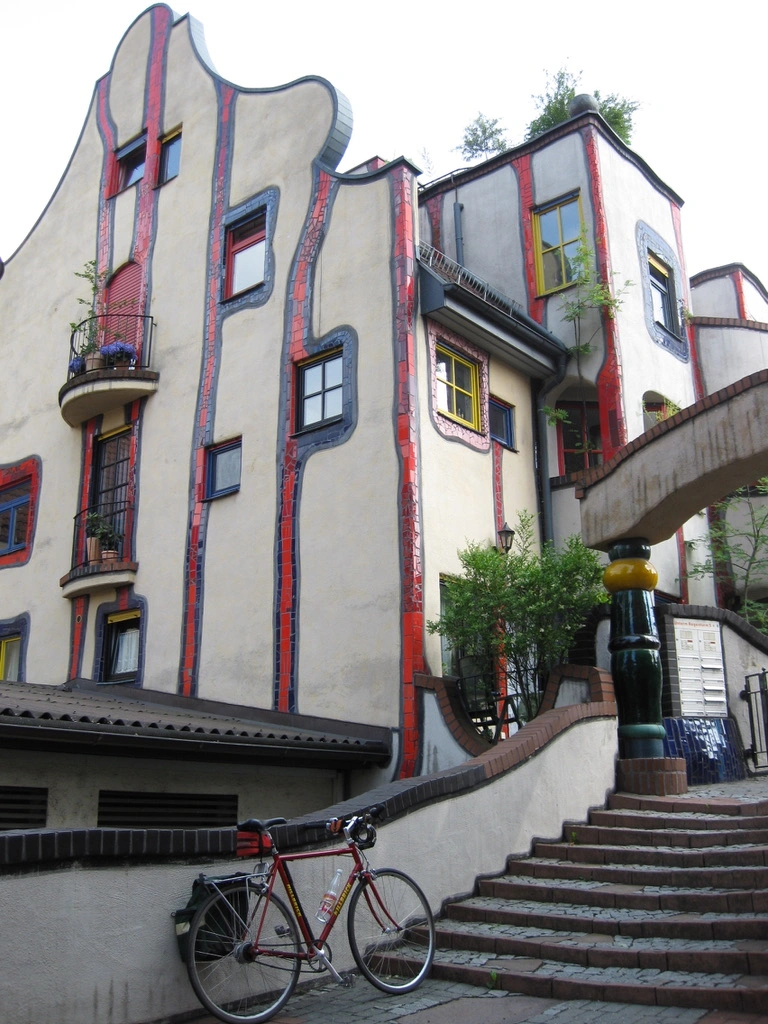
Plochingen, near Stuttgart on the Neckar River, 12 June 2008. 'Die gerade Linie ist Gottlos'. 'The strait line is Godless.' Friedensreich Hundertwasser.
But 'waiting' is indeed another thing - waiting for writing, waiting for art. The waiting in writing and art is waiting for the idea of the work to 'occur' to you. It has to 'occur' to you. Occur is a great word, cos it tacitly acknowledges that you can't force the idea to come. It comes when it comes. BUT, once it has occurred to you - your constellations of characters and what happens to them has emerged from your unconscious - then you go like the clappers. A chapter or two a day for a fortnight and you're done. 20 - 30 chapters. Most of my novels were quickly written: 2 - 4 weeks, which might get stretched out a bit by work or other commitments. But actual writing time - four hours a night, 9pm till 1am, for fourteen nights - ten to fifteen pages a night, at three pages an hour.
Easy peasy. Once you've got your starting point, whoosh - off you go and see where the thing takes you. It gets a life of its own, and as I say, then all you're doing is taking dictation from God.
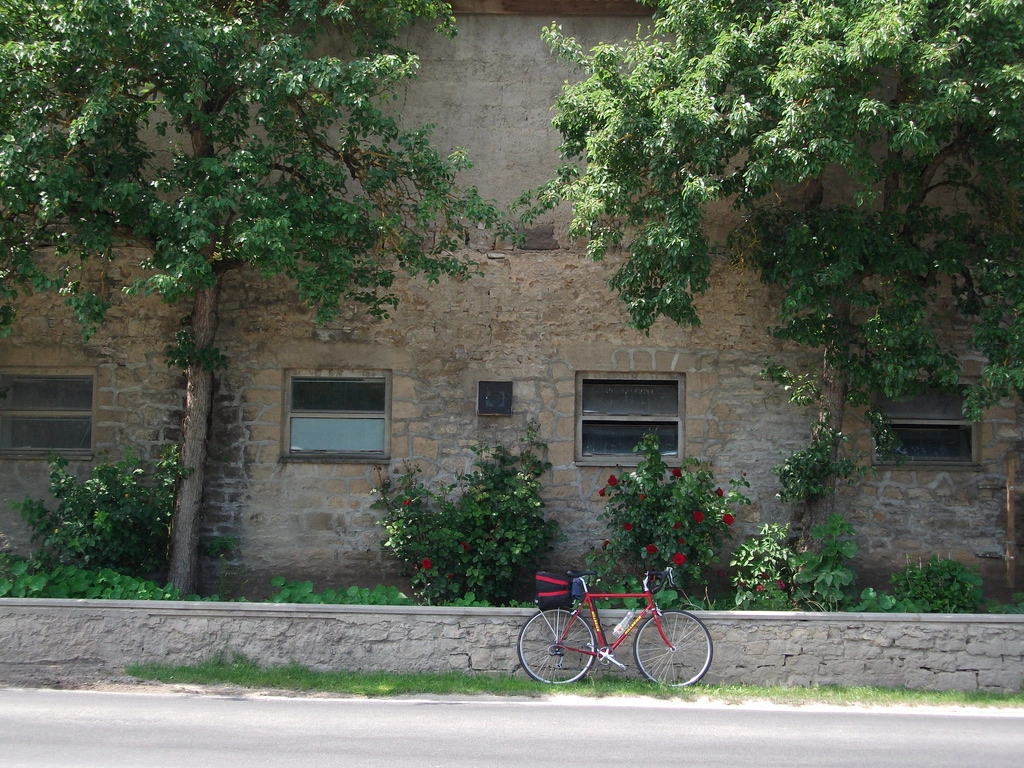
Main River stone wall and trees, near Fahr, 9 June 2010
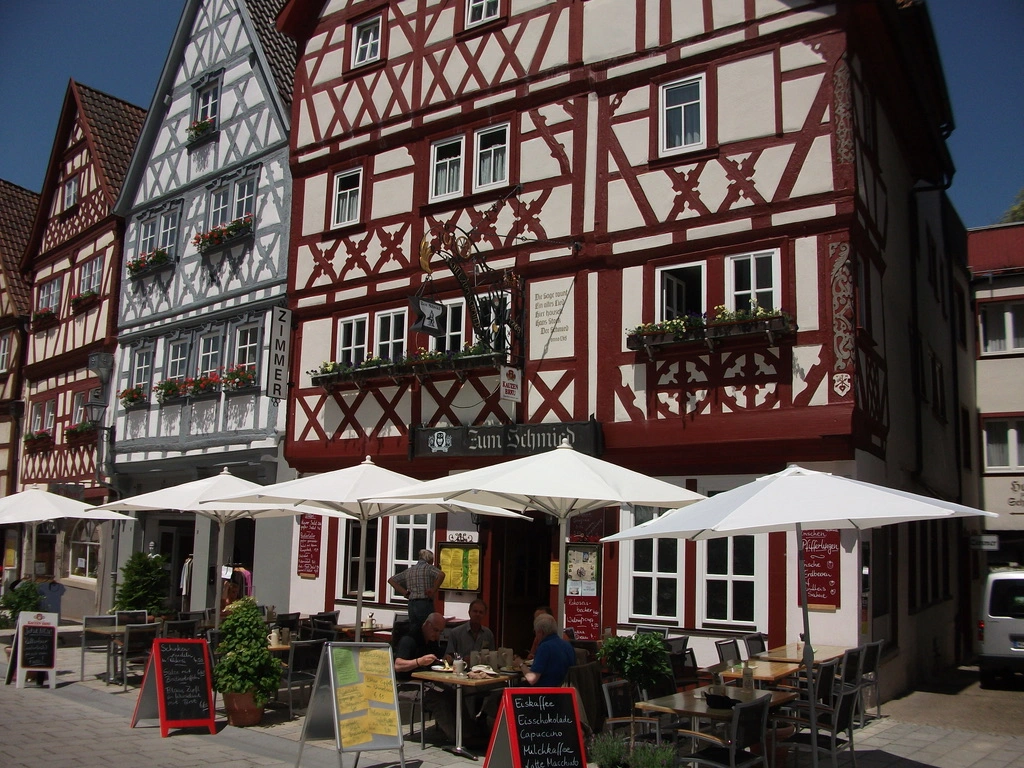
Ochsenfurt, Main River, half-timber row, lunch at Zum Schmied, 10 June 2010
And don't let yourself get interrupted. If you get interrupted you can lose your thread. You have to drop everything else to get it out, with as little interruption as possible. And you never ever talk about it with anyone till you've finished your first draft. That can also wreck your train of thought.
As Wilbur Smith’s agent Charles Pick said to him:
‘Write for yourself, and write about what you know best… Don’t talk about your books with anybody, even me, until they are written.’
Smith has said that, ‘Until it is written a book is merely smoke on the wind. It can be blown away by a careless word.’
And that's Wilbur Smith, hardly the greatest writer to blot paper. But Pick and Smith are absolutely right. You must not allow anything to intrude on your dreamwork. That's what's doing your job for you. And as we all know, dreams can disappear as soon as you wake up and look at the alarm clock to see the time.
If you're not racing ahead, and you're squeezing it out, sentence by agonising sentence, then I reckon you're not a writer. You might like to be one, you might like the idea of being one, but you aren't. Or maybe you were a writer once, but you aren't any longer. Writing shd come easily, once your gestation is over and the bones of the story have occurred to you. Then the thing shd write itself. Heck, it shd be easy. All you shd be doing is recording the unfolding.
It's a kind of Zen mastery - so ingrained it goes by itself. You shdnt have to think about it - at all. By the time I'd written 14 plays and ten novels I was so used to the process I didn't have to think about it. It just happened. All I had to do was get out of the way. (Too many would-be writers and artists don't know how to do that. Their anxieties make it all about them - which means they'll only ever manage to stuff things up in an endless tizzy of consternation.)
Or you might transition from one mode to another. In the past poets tended to be young and male. Sexual frustration has traditionally driven young men's poetry. So once they find a mate and shack up or get married, domesticity and parenthood take over. That's if they didn't first die of melancholy, drugs, booze, or syfilis before a woman changed their fortunes.
Then you might move on to less solipsistic forms like fiction and drama - novels, plays and stories - which are more populated by other people than just the poet and the object of his lust and the cause of his ecstasies and miseries. Dramatic forms become more interesting and possibly even urgent. I know from my own experience that you can get awfully sick of being a lovelorn young man scrawling poems in desperation to gorgeous young women who may or may not be interested in you. That doesn't last - you die or move on to broader pastures. Embarking on novels and plays instead is inherently more outwardly focused than poetry is. Comes a time when a young person just gets sick of being a confused adolescent and grows the fuck up - usually with the help of a willing partner.
Back to the narrative drive... That's not to say that sometimes things can't peter out - they can. Sometimes your idea doesn't quite have the urgency and energy required to make a book. Okay, let it go and let something else occur to you. False starts are okay and normal. All they mean is that the person or people your story was based on weren't strong enuf to bear the burden of the unfolding. Or the process they underwent lacked momentum and consequence. So what. Let something else 'occur' to you. Don't flog a dead horse. You've got to be prepared to abandon starts once they start to fizzle out.
Sometimes God's arrows miss their targets.
So-called writer's block is a myth. If nothing is occurring to you that's just how it is. That's how I know I've written my last novel. The cupboard is bare - there are no more skeletons to clear out. I've got no more people I want to write about. I'm not going to beat myself up over it. If you run dry earlier in life that's also fine - what you've done is all you were ever going to do. Nothing wrong with that. Who says anyone has to write or paint for 50 years, or just 5? Fate is arbitrary and beyond our control. Too often we forget that. Willing yourself to try and write or paint something when nothing is coming - that's a fool's errand. Wake up to yourself.
And that's the trap of self-identification - 'I am a writer' or 'I am a painter or 'I am an artist' is a trap. Don't get caught in it. It's all just something you do - you write, you paint, you draw, you sculpt, you compose - until you can't any more - whenever that is. Such is life.
But there is no point at all in flogging a dead horse.
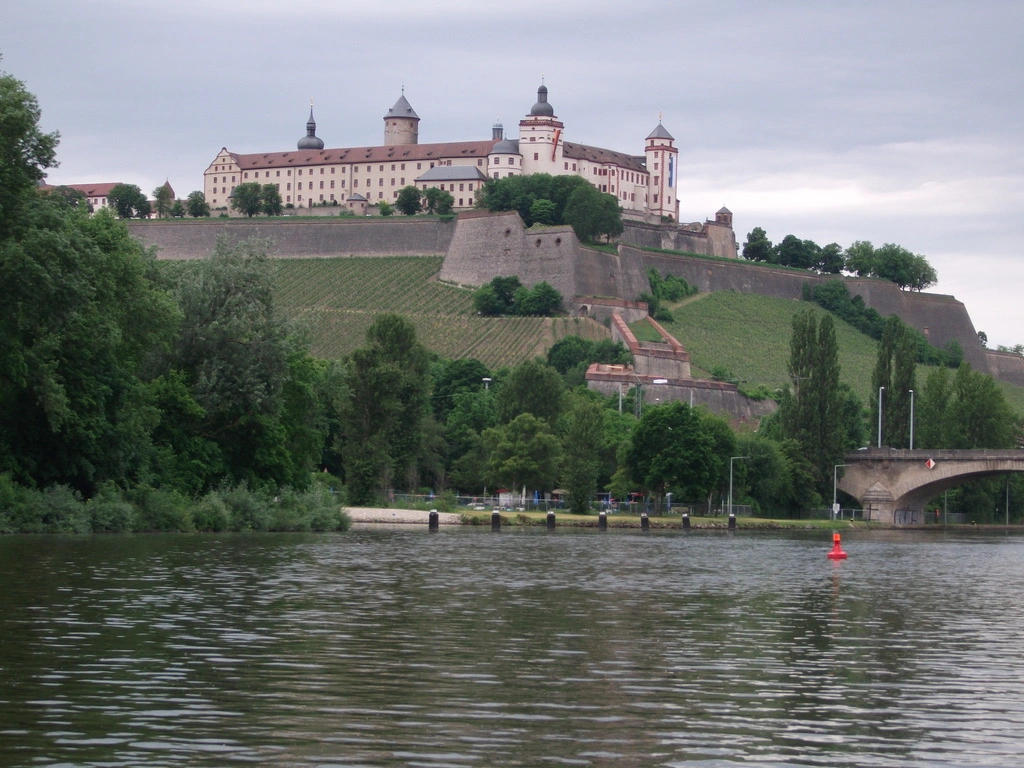
Würzburg, Main River, Fortress Marienberg, 12 June 2010
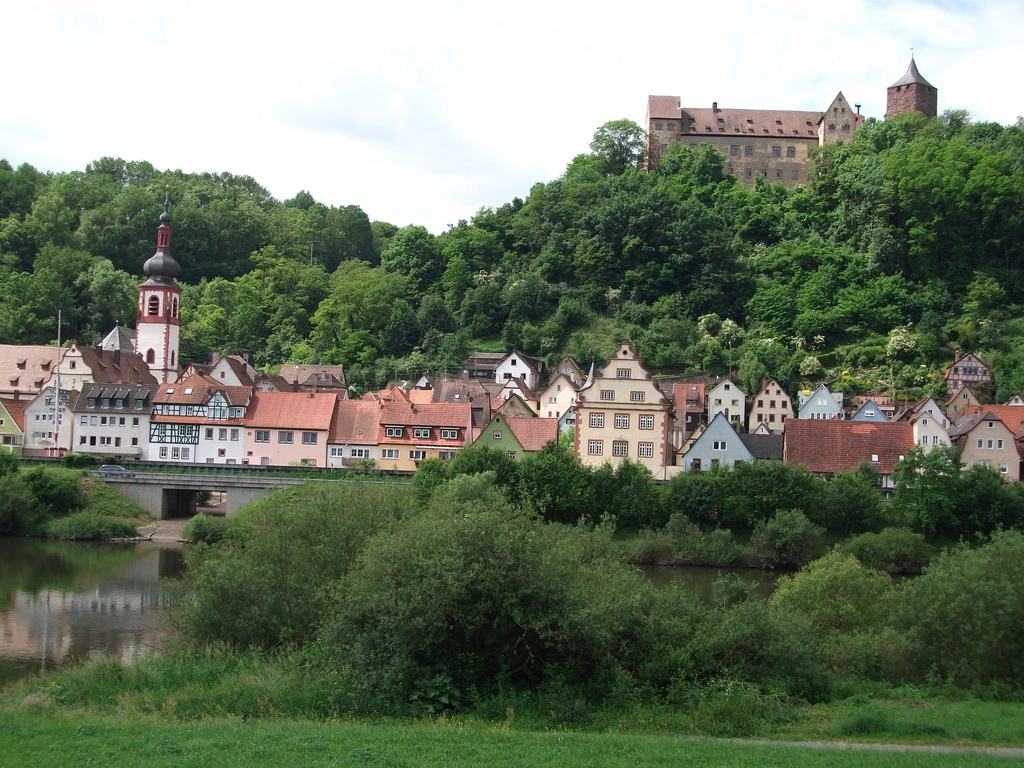
Rothenfels, Main River, 13 june 2010
Intention in writing and painting
Your thinking mind doesn’t always (or ever!) know what your unconscious mind is up to. Your unconscious mind has its own ways and means – best to let it do its thing, and just cream off what ‘occurs’ to you. (It's best to outwit your thinking mind - by whatever means you can find... forget it, ignore it, kick it up the bum, sleep it off, burn it up, bypass it, undermine it, bury it, work too fast for it to stop you... whatever you do, don't let your thinking mind stop you from what you're doing. Your thinking mind doesn't have a clue what you're doing.)
Occurrence is a profound notion in art. Go with what ‘occurs’ to you. It can’t be forced, or pre-empted, or planned, or controlled. It is folly to go against that (short cut to madness, that). Occurrence is waking dream, with dream logics we can but dimly have inklings of. ‘Inkling’ is another very useful notion: ‘occurrence’ & ‘inkling’ - writers' and artists’ best friends.
Inklings and occurrences both harken to the unconscious and the Cloud of Unknowing, our Dreamtime, whence all our artistic impulses come. They refer to the mental mire, the sentient swamp, the cursed cesspool, the layers of mental humus, buried memories and experience our dreams emerge from. It's where our pasts go to die - we resurrect them in our art. Inklings and occurrences are our envoys therefrom - and as such they are the stuff of our artistic works.
Self-talk that actually works, and ought to be your habit-of-mind:
'It occurs to me that...'
'I have an inkling that...'
'I found myself doing this... thinking that...'
They are evidence to yourself that you are listening to what's real inside you. Take heed! Listen to your 'non-sense' - it's got more sense than you know.
If we can‘t bypass that ‘controlling mind’ while we’re working, we can with time forget it, and then see with untrammelled eyes the worthwhile in what we did some months or years before. The object itself – painting, sculpture, piece of writing – has a life of its own, independent of what we were thinking at the time of its making. With time and forgetting, it ceases to be 'ours', in the possessive ego-bound sense that we can have so much difficulty in escaping, and which so hampers our fair view of what we've done.
Paradox: while its 'mine' I can't see 'my work'. Once I've forgotten it, and it ceases to be 'mine', I can re-see it, with fresh eyes, and perhaps recognise worth I wasn't able to see before. Escaping yourself becomes the primary task of the artist or writer - for the sake of your sanity and for fair appraisal of your work. Sometimes you're better than you think you are.
In that very real sense, no artist can ever encompass their work entirely. Some or much of it is always ‘beyond’ them. You have to learn to trust that, and accept that. It’s a form of radical humility. Our works are larger than ourselves, cos they never really were ‘ours’ to begin with. An artist is just a conduit for greater things. I take dictation from God. I am not the God who dictates, nor am I the stuff of the dictation. I am just a means, a medium, an agent, a conduit… the scaffolding for a building while it's being built, to be discarded thereafter… I don't matter a jot - but the work does... and it helps me to think of it as 'not mine'. It belongs to 'everything'. Which makes it mystical.
It helps to realise that you are a mystic. It depersonalises it all. Which takes the pressure off. You're just a small part of a very large universe. Why worry? Just use your gifts and do justice to your life and experience, and that of others. Nothing else matters.
Intention is a double-edged sword when painting or writing. We need some sense of what we’re doing, if only to keep our intellect busy while our dreamwork is doing the real work. But the gap between our perceiving mind and our creative mind is best when it’s narrow or even non-existent. (Speed can help overcome this - work fast! Working slow leaves too much time for dout and overthinking.)
Paradoxically, intention is never the driving force in painting or writing anyway. Intention can help us shape and see what we’re doing, but equally it can get in the way. So it’s best to ‘get out of our own way’ till we’ve ‘finished’, then leave it alone till we’ve forgotten what the intellect thought it was doing, and then see what we actually have done.
As Graham Greene said, it’s only with hindsight that we can see what we’ve done. While you’re doing it you can’t see what you’re doing. You just do it, trusting that your unconscious mind knows what it’s doing, then, once done, you step back and look. Then, if you’re lucky, you go, Ah, so that’s what it was… as tho you had nothing to do with it. Making art is like an out-of-body experience.
Thinking of ‘lost wax casting’ is useful. Once the sculpture is done, you melt the wax that shaped the molten material. Once melted it leaves no trace. Then we can see the finished sculpture free of the wax. The wax is something the sculptor has to know about and understand the process of, but all others’ views of the work need never know that stuff. It’s just a means to an end, essential as such, but otherwise of no value. (Who remembers the scaffolding once the building is completed?)
And in all of this, ego is just an obstacle, something that gets in the way. Get out of the habit of thinking it’s ‘I’ who is painting, writing, whatever. I’m just the pipe thru which the dreamwork flows. I let it flow, without thinky hindrance. It’s not about me, even if it is.
That’s the paradox. Which oddly can look very much like unfettered ego at work. But the reality is, that the flow, which can so deceive others as to its origins, and indeed look like gross ego, is just what happens when you’re letting it flow. It’s not you, it’s the stuff of dreamwork itself rushing into shape, form and view… which is among other things an esthetic process. (Without shape the energy is too raw to take in.)
Here endeth the flow, or this particular flow, for the time being…
Gasthof Mainblick, Marktheidenfeld, 13 June 2010
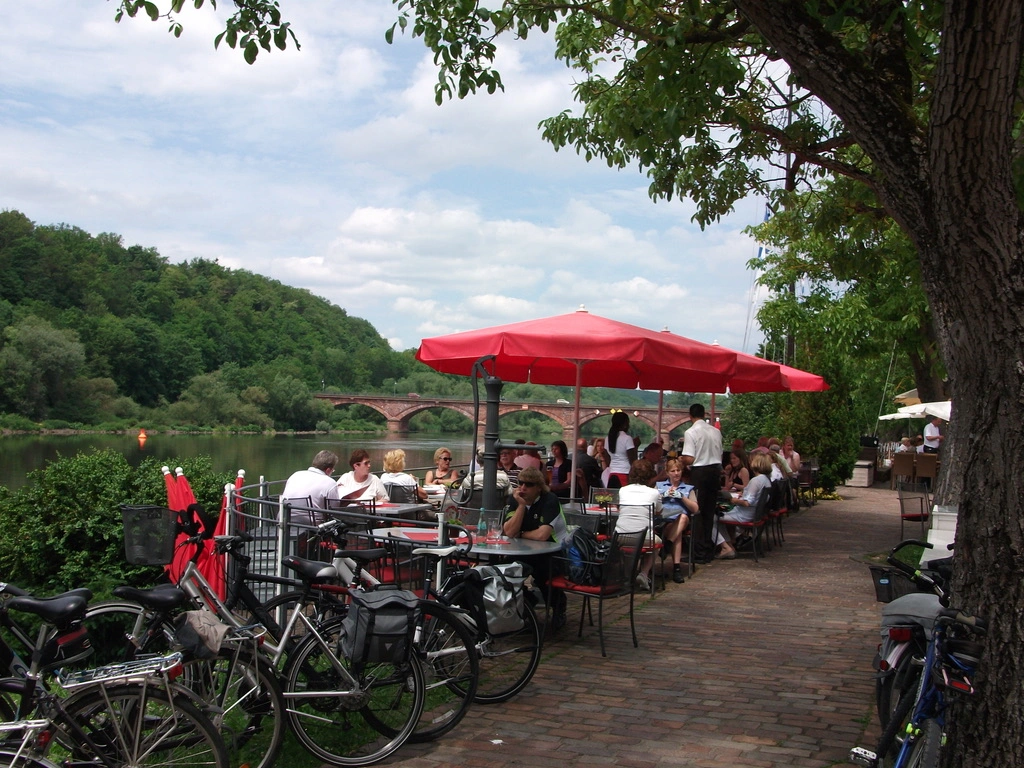
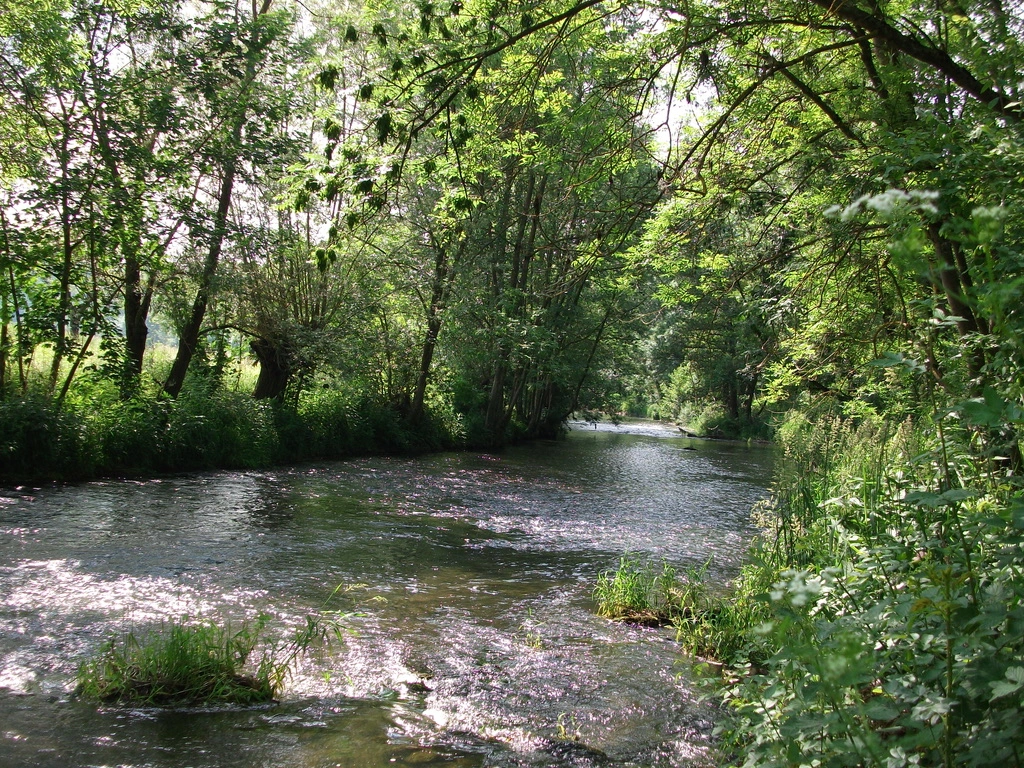
Tauber River, 15 June 2010
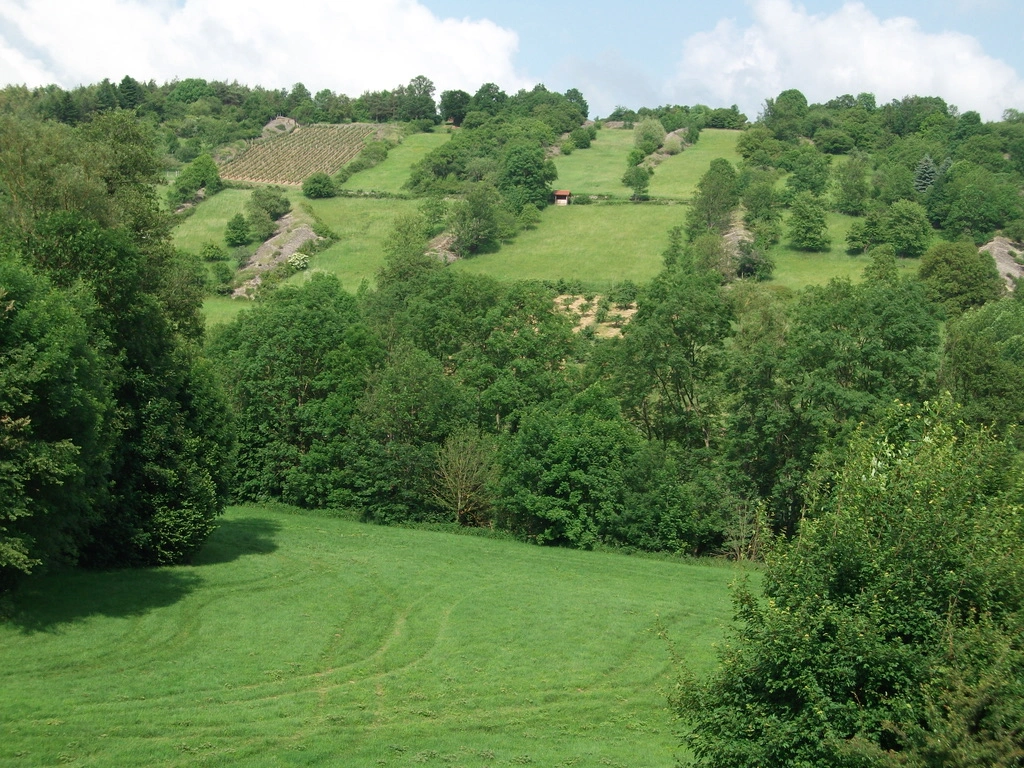
Tauber valley, 15 June 2010
Response to responses to these musings
One of the questions some people ask after they’ve read my novels is ‘which bits actually happened and which did you make up?’
The preceding passages about 'the creative process' are my attempt to ‘explain’ the inexplicable.
This is something that those who don’t create never understand about creativity, namely that it’s usually an amalgam of ‘real’ and ‘unreal’ in ‘possible’.
I don’t think painters get that kind of quizzing of ‘did that happen or not?’ The painting is its own evidence, and is automatically seen to be a ‘representation’.
Fiction tends to be regarded by some as imitation reality… which it is! We are making things up - but the made-up is made up of real things, experiences, understandings, insights... But that’s a good thing, not a suspect thing, like some think it is.
It's not subterfuge, or worse, 'cheating' - it's grappling with reality. I'm not trying to trick you. I'm trying to make sense of things, not hoodwink you.
It seems to disappoint them when I say it’s not such an easy split between ‘happened’ and ‘didn’t happen’. Sometimes it all happened, but not necessarily to just me, or just to one other person – it sometimes happened to various people and not in any kind of chronological order.
They want it to all be ‘true’, and think less of it if they’re told I might have made some of it up, or pinched bits from here and there, from 30 years ago and last week. Somehow they don’t like the idea of ‘make-believe’, when it’s all bluddy make-believe, no matter what.
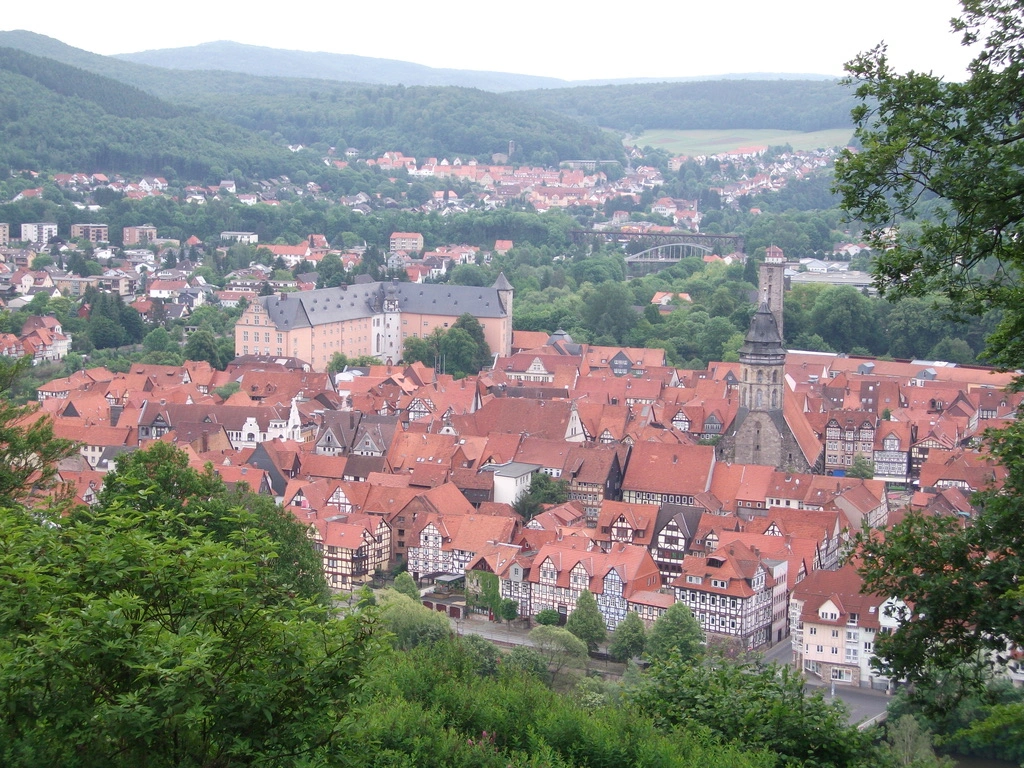
Hann Münden, at the confluence of the Fulda and the Werra Rivers, 6 June 2012, on a typical hazy late spring day. One of the finest half-timber Altstadts (old towns) in the land, born of the wealth of the medieval Hanseatic League.
I wasn’t entirely surprised that a mild challenge was made to my claim that most poets tend to be 'young and male' – ‘most poets today are young and female’ was the rejoinder. I was thinking of the past, and in fact said so in the next sentence. And I now have:
‘In the past poets tended to be young and male. Sexual frustration has traditionally driven young men's poetry.’
I know there have always been women poets, but the fact is that it’s mostly men who have come down to us from the past. I don’t see any point in denying that, for the sake of political correctness. Most painters in the past were men too – it’s pointless to deny it. You can argue about why till the cows come home, and also be grateful that things are different today.
The point is sexual frustration has always been a big driver of poetry, for any young person, male or female.
Look at all the folk and pop songs over the years - they're all about 'lurv'.
And mostly, finding a mate and becoming domestic lessens the impulse.
It was also put to me that perhaps a better term for ‘my God’ is ‘the Muse’. I don’t think so. Muse is a smaller scope, is usually one actual person, tho it is sometimes abstracted, and doesn’t suggest something much greater than the poet. The word ‘God’ has its uses, and that’s my point. I cd say Muse, to escape the interference with the word ‘God’, but Muse just doesn’t do the job for me. My explanation of this will have to do as it is.
It’s just a shorthand way of acknowledging that the gift is not internal to the writer, it is external. Too many people, writers and readers, get lost in this false idea that what they’re writing or reading about comes from within the writer, and that what they’re trying to do is ‘get the inside out’. That it’s some kind of ‘self-expression’. Nothing cd be further from the truth. If fiction and art are just ‘self-expression’, let’s all just pack up and go home.
It seems that some are bothered by my invocation of God for this purpose. I maintain it doesn’t matter. Let God be God for this purpose. If it’s understood to be for this purpose then it can serve that purpose without invoking all the baggage of the whole notion of God the Father the Almighty, Creator of Heaven and Earth, of All things Seen and Unseen, etc. We’ve got to get beyond being hung up on these old usages, and refashion them for our own purposes, one of which is mine in trying to explain what I mean by creativity – which is ‘taking dictation from God’.
It boggles my mind that so many people, even those with substantial interests in ‘the arts’, just don’t get that self-expression is not art unless it is also symbol-making and thus transcends the merely personal. Fiction that is mere anecdote or mere whodunnit is not art. Painting that is just a ‘good likeness’ or a ‘nice design’ is not art either. The material has to undergo a transformation to the point where it’s no longer the sum of its parts, its details, its making. The whole has to be greater than the sum of its parts.
That this is ineffable doesn’t help us understand or discuss this, but nevertheless, without this dimension – call it timelessness, or archetype, or symbolism, if that helps – but for art to be art it must achieve a level of symbolism that transcends its particularity - thru its particulars, yes, but it gets beyond them.
It’s like Charlie Chaplin being understood by African tribespeople. None of them wore his black baggy trousers or bowler hat, nor did they twirl a bamboo cane, but they ‘got’ the emotionality of his body language. Chaplin transcended the details, and necessary details they were too, to achieve universality that people from other cultures cd recognise and be moved by.
The Muse is just the person, dare I say the woman, being pursued and venerated - the object of desire. (By all means switch it round so the muse is male for a female poet.) What I shorthandedly call ‘God’ is far greater than that. God gives me the stuff of my stories. I just write it down. I am God’s pen. I am God’s keyboard. It all comes from outside thru the writer onto the page. The writer is prism and conduit.
That’s news to most people, including most writers, whose way of talking about themselves and what they do is often remarkably counter-productive. Even if the material the writer is dealing with is personal, and even ‘happened to them’, the story paradoxically has to come as an outside impulse, and what’s more, be felt to be so. It has to be impersonal, or if once personal, eventually it has to be depersonalised… by time and forgetting and transmutation… returning to earth…
That’s why you can’t write good fiction about what happened to you yesterday. As David Malouf said, it takes about 25 to 30 years for personal experience to become ‘impersonal’, so it can be written about in a way that is no longer rawly personal, but which by then has something of the archetypal and symbolic about it. The personal experience has to become something else, something qualitatively different - it has to undergo a transformation.
As an aside, this is why a lot of writers only ever do their 'first novel', invariably a coming-of-age ditty, then never write anything of any consequence afterwards. They have to wait 25-30 years for whatever experience they have as young adults to become the grist of worthwhile novels with useful social and experiential engagement. Waiting for that is what undoes them - after 25-30 years they're usually doing something else.
Poetry yes – poetry can be about the girl or boy who knocked you back five minutes ago – poetry can be a scream of pain, or a growl of lust-love, or something else immediate. You don’t have to wait thirty years to gestate that!
Cos poetry is inherently solipsistic - it's only about you, it’s not social, it’s not larger than you, like worthwhile fiction is, and has to be.
And the person you are writing your poem to is your Muse. Poetry has muses. The Muse is the person you’re desperate to fuck. Novel fiction doesn’t have muses, cos it’s social, not merely personal. You can’t fuck all your characters or all your audience, and you’re not trying to.
Poetry is solipsistic and adolescent. Fiction is social and adult.
Otherwise every diary entry cd be passed off as fiction – which it isn’t. They are qualitatively different. If fiction is to transform experience, it must wait, and be waited for.
Like hunters, writers lie in wait for prey.
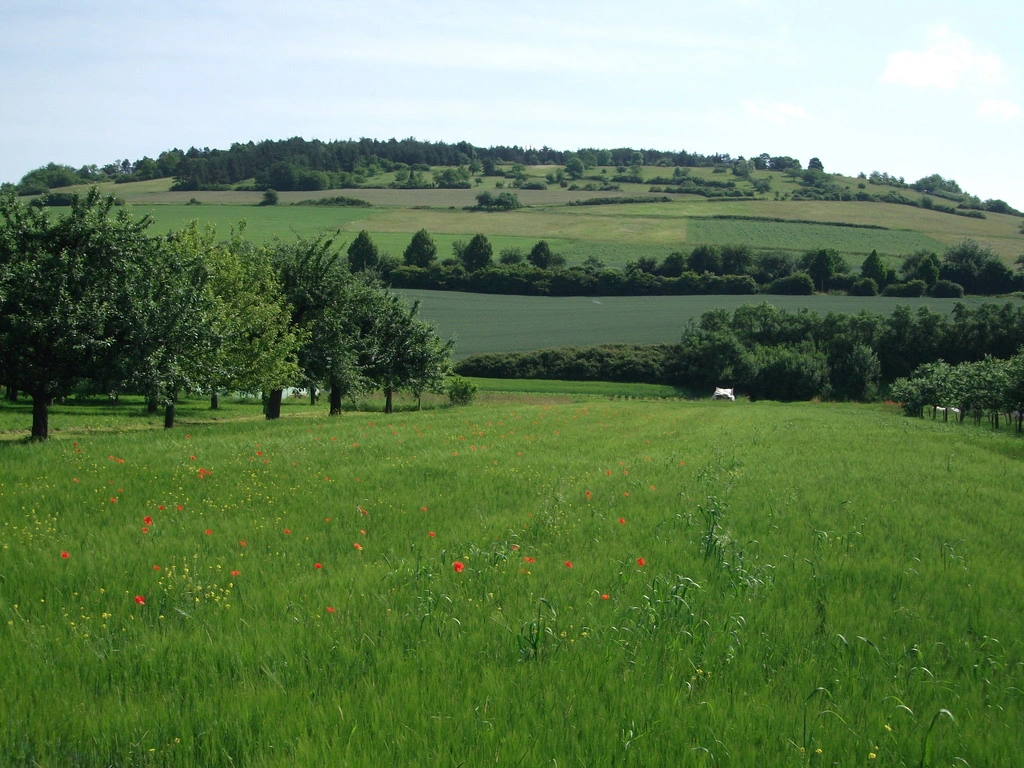
Tauber valley near Bad Mergentheim, 16 June 2010
It’s a bit like forgetting a painting. It takes the passage of time for it to be no longer the personal impulse that you can’t see properly, cos it’s too immediate and personal to you. It takes time for the painting to become no longer ‘your own’ – to become impersonal. Once it has become ‘impersonal’ you can re-see it and re-judge it.
In writing, your own personal experience has to be like fallen leaves that rot over time to become humus and return to soil, whence new leaves can grow. Unrotted leaves are no good for growing new leaves – they’re still leaves that haven’t rotted back to their constituent minerals – they are not yet ‘soil’. They are not yet ready for uptake by new seedlings.
Likewise, your own experience has to break down so it can be re-used for story. That takes time.
(As a side observation, the traumatic experience of things like war can mean that the people who lived thru war, like my father did, are never able to talk about it for the rest of their lives. It's too much to break down. Which is why art never really conveys deep trauma. At best it skirts around it, but rarely does it tackle it head on. It's too hard.)
That process of becoming impersonal is what allows the stuff of your work to become something outside yourself – greater than just you yourself, subsumed in the spirit of the times, such that your characters and what befalls them can become emblematic of the times in a way that can touch other people and mean something to them. Without that transformation and subsumption into the broader world, your experience and knowledge will remain just yours, and as such relatively inaccessible to others.
That’s one of the differences between ordinary people who write and great writers. A great writer has a way of fusing their own experience with that of others so it all becomes a kind of group experience that readers, people, can identify with and see themselves anew in.
That’s not wallowing in personal misery, it’s being in tune with the world, with other people, and being able to find the general in the particular, the symbolic in the detail. It’s also seeing that what you might at first have felt to be ‘just’ your own personal suffering is also like, or the same as, the suffering of others. That’s where imagination and empathy come in. Your personal gets fused with others.
And it takes time to realise that. It can’t be hurried. It can't be hurried cos suffering turns us inward, makes us self-centered... cos we can't overcome it at first, it's all unbearable pain and 'Why me?' Getting beyond that is what takes time. And sometimes forever.
That comes from outside, that’s real listening to what’s greater than yourself and outside yourself, that’s taking dictation from God. For want of a better term. And accepting the inadequacy of one’s terms is part of being able to deal with imperfection and not strain at it to the point of self-defeat. God will just have to do… if we are to make our own personal suffering part of the main, make it symbolically accessible to others, so we and they can all see ourselves in what we once thought was merely our own indescribable pain.
Another thing - the blood-curdling scream of pain at the first onslaught of suffering is not art either. Art must wait for its moment of calm recollection. Impatience to get from the scream to the calm can be the undoing of an artistic impulse.
At first all suffering thinks it is special, ’nobody else knows what this feels like’. The suffering will remain acute as long as we think it’s ours alone and special. It will abate once we begin to realise that it’s not just ours, it’s common, and it’s everybody else’s too. It’s human. Self-pity becomes pity for broader humanity – suffering is our common fate. (That is also the step from the personal misery muddle to wisdom.)
In the American universe, where ‘all men are created equal, and are endowed by their Creator with certain unalienable Rights, that among these are Life, Liberty and the pursuit of Happiness’, this stoical attitude to suffering has become harder to see - and harder to live. (It gets drowned out in the treat-me-right hubbub of fatuous anti-social media.)
And for countries like Australia, insofar as we are ‘infected' by America, in our increasingly shaky Pax Americana, we too share in this delusion.
Paradoxically this has led to an increase in suffering and self-pity, cos when bad things happen to Americans they get all sooky about it. They think, Why me? This aint fair! What do I have to do to escape this? So they flail about, looking for quick fixes and cheap salvations, and produce the nightmare that is present-day America, which is among nations the most like a headless chook, where a whole population thinks it’s special and doesn’t deserve to suffer. What a bunch of idiot children they are!
And the biggest idiot child of all is now running the joint. Trump is not exceptional in America. He is the ultimate expression of that mentality. He is what happens when the ‘pursuit of happiness’ loses its bearings and becomes evil itself - the Devil takes the hindmost.
Polemics aside, the point of this, regarding art, is that ultimately it’s all about how we suffer. The worth of our stories and our paintings is all bound up with how well we listen to God, how well we harken to all that is larger than we are. Therein lies our service, both to ourselves and to humanity at large. It is never ever just about ‘me’.
All we shd do is listen to God, and transmit what we hear. That’s all, and that’s everything.
That ought to take away all your fears as a writer or as an artist. You shd never be worried about what others think of you. You are just God’s servant, you are just doing God’s bidding. That’s enormously freeing. It’s only ego that is afraid of what others think, that has performance anxiety, that cares for the good opinion of morons. God has chosen you, given you your gifts – who else has 'given' you your gifts?! (You most certainly didn't give them to yourself! You can't 'choose' to be gifted.)
It’s your job to do those gifts the greatest justice you can. C’est tout.
Tauber River, 16 June 2010
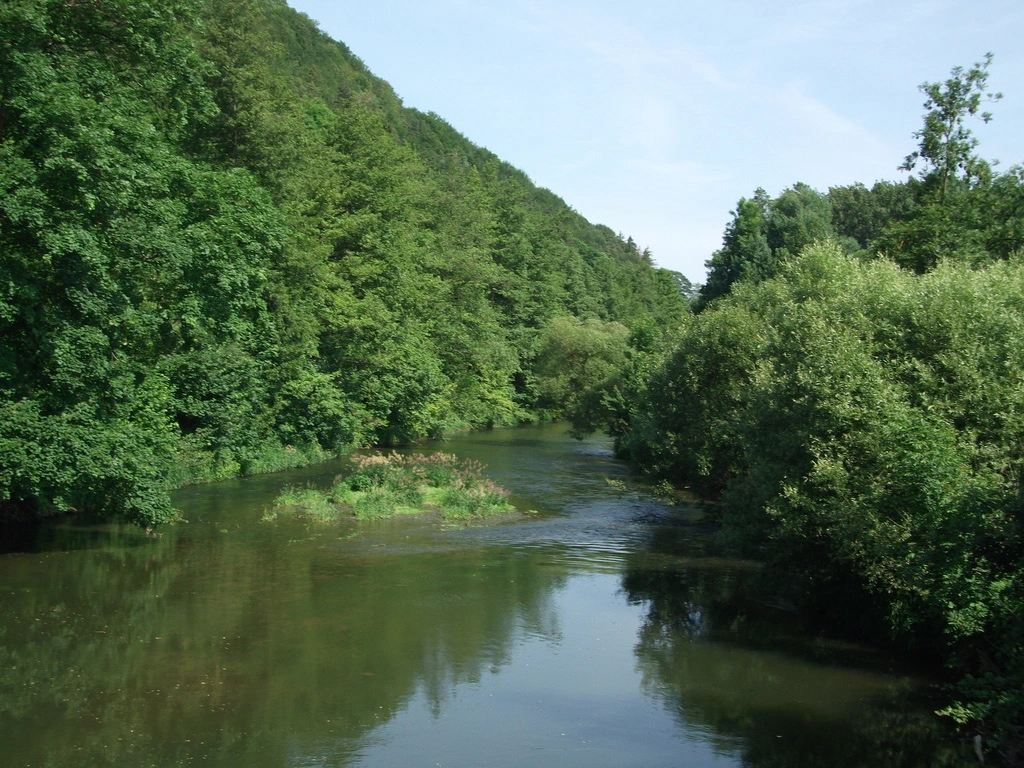
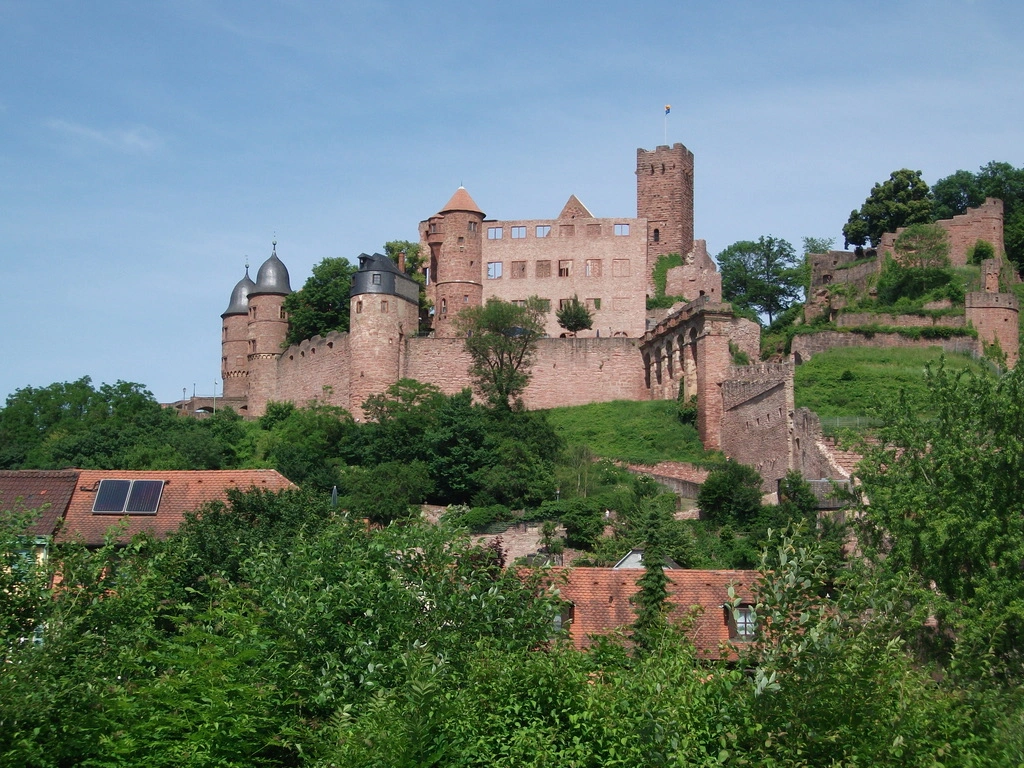
Wertheim Burg, 17 June 2010 - Tauber Main confluence
Rollsing on: the importance of unimportance:
Just one more thing regarding THE END OF WHISTLING and COLD WAR CONTEMPLATIONS, and indeed my travel PDFs, AMONG THE GERMANS, and my accounts of my times in hospital:
I take very much to heart the insight of Les Murray into Eric Rolls, whose wonderful book A MILLION WILD ACRES, about the history of the Pilliga Brush, is one of the seminal Australian books.
Murray points out that Rolls has a way of looking at things without 'filters of significance’. He sees all things as equally important. He has no ‘hierarchy of importance’, that sees ‘lesser details' and 'lesser things' not given their due attention. Murray says that hierarchical ordering of experience is European, whereas Australians, when they’re not trying to be European, don’t subscribe to such hierarchical notions and categorisations of experience and fenomena. Europeans are vertical, Australians are horizontal – naturally democratic, which Europeans are not.
Here is a good summary of an important perspective – Les Murray and Eric Rolls and the ‘democratic recognition of all life’ – an Australian perspective we haven’t inherited from Europe. Les Murray: Eric Rolls and the Golden Disobedience, by Tom Griffith.
https://insidestory.org.au/golden-disobedience-the-history-of-eric-rolls/
It informs my sense that writers shd treat everything equally, the apparently unimportant and the apparently important.
There is no ‘hierarchy of experience’ – it all matters. The extent to which we invest in hierarchical approaches to experience is the degree of our delusion.
I too tend to record all manner of things, important and unimportant alike, cos I too, like Rolls and Murray, have a very Australian sense that everything matters, cos everything goes into ‘everything’. There is no hierarchy of importance. Everything matters. And the devil is always in the details. (For want of a shoe the horse was lost, for want of a horse…)
European hierarchies of importance are endemic to European culture, and boy, doesn’t it show. We’re better than that, when we’re being our true democratic selves, rather than aping Europeans.
Les Murray: Eric Rolls and the Golden Disobedience was published in PERSISTENCE IN FOLLY, as the foreword to the 30th edition of A MILLION WILD ACRES, and was also included in Murray’s selected essays THE PAPERBARK TREE.
Hence tho in my work I sometimes go into 'unimportant things', 'trivia', in ways that some readers find puzzling. They wonder why I bother, and they think those things, those passages, are 'boring'. All I can do is refer to the above defence of 'unimportance'.
And, if you really do find a passage irredeemably dull, then skip it and find the next nugget of 'important stuff' worth thinking about. The 'longueurs' don't last that long, and you can always make them shorteur.
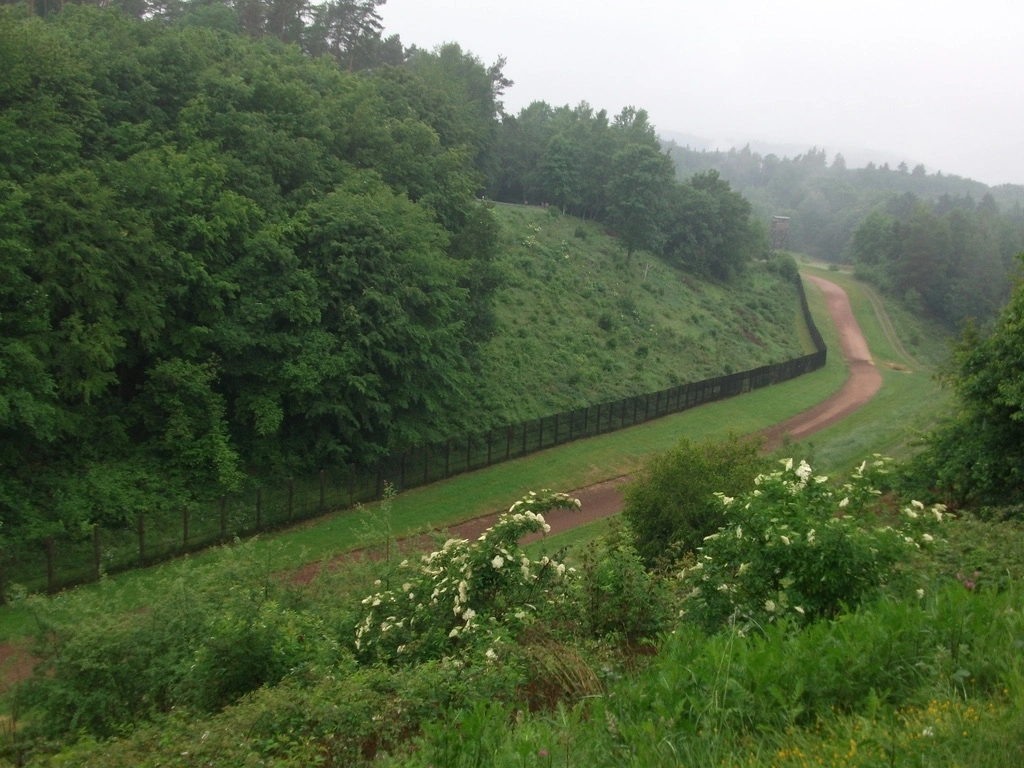
Remnant of the old Iron Curtain, the border between communist East Germany and free West Germany, at Schifflersgrund near Bad Sooden-Allendorf, 3 June 2012.
God is a word for what is beyond our ken. That is useful.
I'm just reclaiming God for my/our purposes, which is to name and acknowledge what is beyond our ken, for that is the source of our inspiration - the gifts and the impulses that make us make art or write stories.
As Denzel Washington said when asked how he prepares for a role:
I do all the work then I let it go. I don't think about it. I don't decide how you're gonna feel about something I do. I don't even know what I'm gonna do. I've been blessed with a God-given ability to interpret. And I just let it go - let God handle it. I do my homework and see what happens.
That's exactly how I feel when I'm writing. That's true for anybody who is any good.
In a world where our own will and agency is held to be the highest personal accomplishment - 'I am the master of my fate, I am the captain of my soul', as William Ernest Henley's 1875 poem Invictus famously has it - it sounds crazy and against common sense to make such a claim.
But Denzel Washington is right, and he is a great acter. And he is surrounded by the bullshit of America.
That our dominant individualistic ideology claims we are 'masters of our fate' is a source of tremendous confusion for many people.
Our hyper-individualism does us no favors. We expect too much of ourselves, we expect too much control over our lives, and we get awfully upset and disappointed when we fall short of such dangerous ideals, as we inevitably must.
It can be difficult to achieve a balance between ambition and fatalism in our lives, but too many are undone by the delusion of control over chance. Chance plays a far greater role in our lives than we currently accept. And so does God. Whatever gifts we have are God-given. Our only duty is to do the best by those gifts we can.
And if 'gifts' must have a 'giver', and we don't know how to name that giver, then let us call the 'giver' God. It's that simple. You don't have to believe in 'God the giver of gifts', but you do need a name to acknowledge the fact of your gifts.
Cos if you can't acknowledge your 'gifts', then you're in trouble. You can't understand or deal with them properly. And that's a road to ruin.
That's a high price to pay for the purity of your belief that there is 'no God'. Who cares if you do or don't. Your 'belief' is beside the point.
But your correct relation to your gifts is not beside the point. That matters greatly.
All sorts of life-defining things are 'given' to us: our health, our diseases, our accidents, our bodies, our aptitudes, our gifts, our families, our friends... All kinship and friendship is the result of pure chance and is beyond our control. Who we meet is beyond our control.
Oh, we can put ourselves in favorable places to meet likely friends, but the right people still have to happen along for us to engage with people who suit us as companions. We can never know who they will be till we've met them. And, granted, we can tend our friendships, or neglect them, or circumstances and inclinations can change friendships and relationships, and even end them.
And then, how long are we sometimes lonely? And feel that no one loves us?
But such changes in our lives are beyond our control - perhaps specially when we delude ourselves that we are in control. (We may 'decide' to do something, but are we really 'in control'?)
The best we can do is, as I like to say, 'give chance a chance'. As Louis Pasteur said, 'In the fields of observation, chance favors only the prepared mind', which means that it's only with a prepared mind that we can recognise the results of chance and make use of them. That is, we can prepare our minds, but we can't control what occurs by chance or when. That comes to us when and where it will - quite beyond our control. Like death, we know not the hour or the day.
That preparation is the closest we can get to having control over our lives and our work. Compared to the workings of chance / fate itself, it's small beer.
It's best to be thankful for what we've got, and indeed revel in it... but not bemoan what we don't have, and think that just by wanting it we can have it. By wanting what you can't have you're just risking the modicum of contentment you do have, with constant striving and seeking for the things you think you have to have 'to be happy'.
For example, the constant folly we see around us of perfectly fair-looking women seeking some ideal of 'beauty' they've been infected by on the internet, and uglifying themselves with implants and myriad 'treatments' that only make them more unnatural looking.
That's the road to misery. Buddism understands this. Desire, attachment is the source of unhappiness.
Tauber Kette Hotel, Wertheim, 17 June 2010
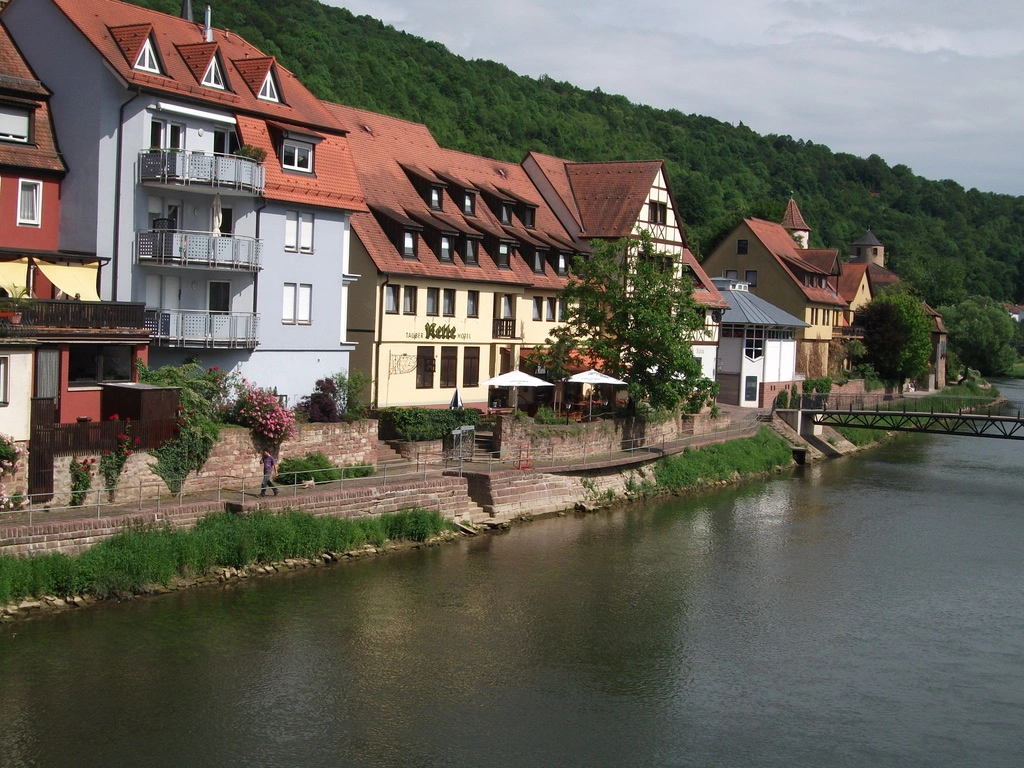
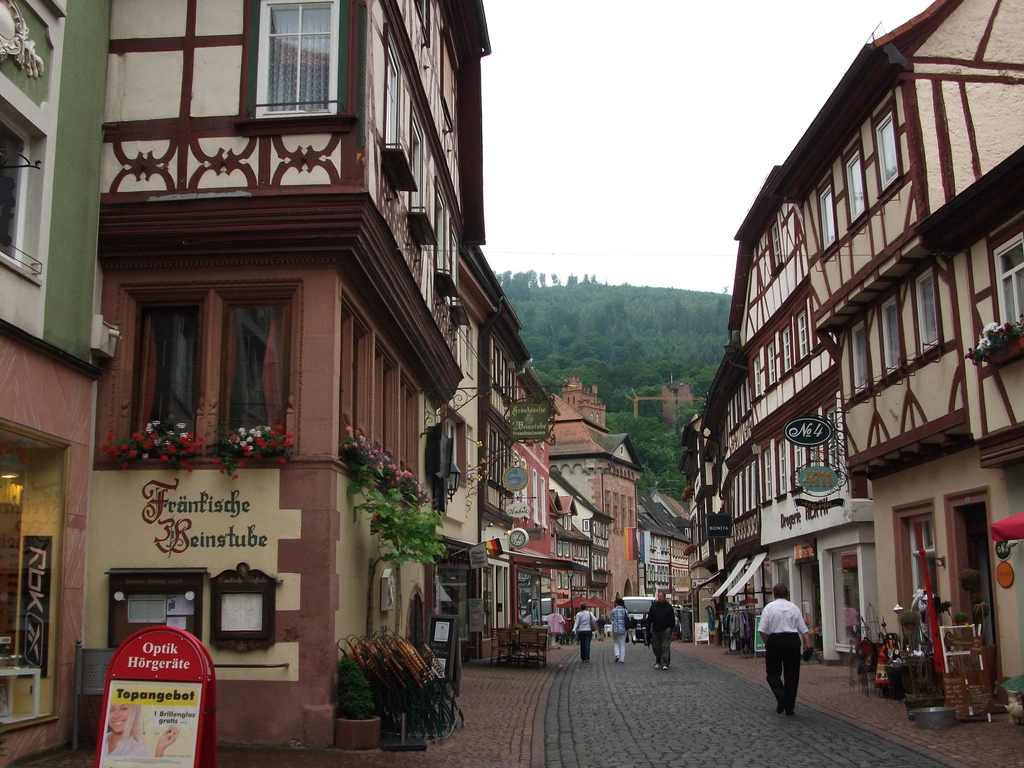
Miltenberg, Main, 17 June 2010
Not I, not I, but the wind that blows through me!
D.H. Lawrence - 'Song of a man who has come through.'
This is very a propos. Lawrence also said something else I like to repeat: 'Trust the tale, not the teller'. That’s spot on. His trouble was he didn’t trust his own tales himself – he was plagued by anxiety about how readers wd ‘receive’ his ideas. He didn’t trust his own tales to do the job he wanted them to. He was too much of a control freak, didn't trust his readers, and suffered greatly from the anxiety that underlies that outlook.
While I have found that some painters, as with some musicians, can be extraordinarily articulate about their art, plenty are not. Painting is not a verbal medium, and not all painters have a facility for finding the right words for things, particularly difficult, ineffable things. Moi au contraire have spent my whole teen and adult life in constant search of les mots justes. An occupational hazard / requirement that gives me an advantage. I’ve had lots of practice!
I’m used to finding words inadequate and don’t expect to find perfect formulations. I don’t strain, I let the most adequate be the least inadequate and move on. I find that people are pretty good at reading between the lines anyway – I’ve even come to trust that in readers. And if they don’t get it, or get it all, well tant pis. It’s an imperfect process, and I can’t control all responses to the nth degree.
The thing is that this attitude paradoxically results surprisingly often in adequate formulations. The ineffable can be surprisingly effable after all. The less you strain the more you attain.
Getting ‘outside yourself’, or not even thinking it’s ‘you’ in the first place, really helps. I have felt for so long that my own novels and plays came from ‘forces beyond my ken’ that I just don’t have this kind of anxiety. As far as I’m concerned they all wrote themselves, apart from Cicada, my first one. That was more of a struggle, cos it was more poetry than fiction, really. But once I’d got that one out of the way I just flew thru the others.
Some writers and painters don't know what it’s like to ‘fly’. Flying is the joy of it.
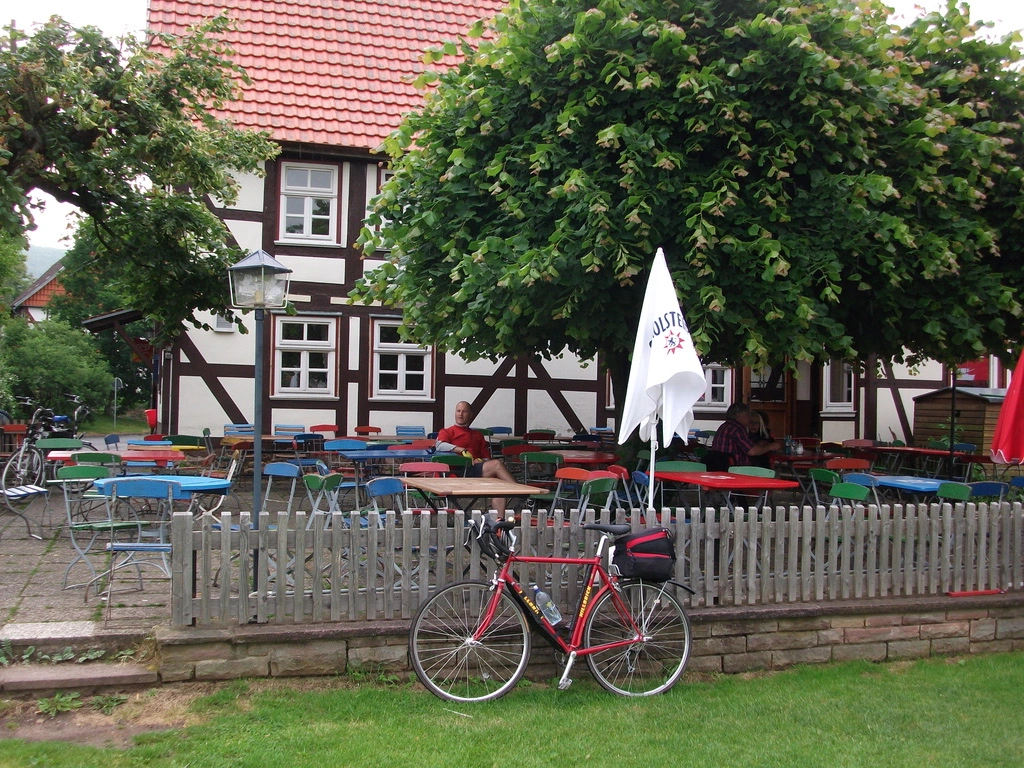
Hemeln Zur Fähre (Ferry Pub) Biergarten, on the Weser River, 6 June 2012. My bike and bursting rack pack as my only luggage.
Speaking of acters… I love the Denzel Washington quote. He just lets God work thru him. Simple! Doesn’t that take the fussing and frustration and inhibition out of it?! The other thing is it lets spontaneity play its essential role. Things stay fresh and unpredictable, cos not even you, the conduit, knows what's going to happen. Only God knows.
And it was English actress Juliet Stephenson who gave me the ‘conduit' word. She said the acter is a conduit. Amen to both of them. The best acters get this, cos they realise that that is what they in fact are doing – ‘channeling’ their characters… it’s not about them…
(And I suspect that acters know this better than writers and painters tend to... cos the acters didn't write the script, someone else did, so in a real sense, they know they're 'just' the means by which the script comes to embodied life. Writers and painters are therefore much more prone to being caught in the bind of being the ultimate progenitor of a work, with all the burdens of 'ultimate authorship' that ensue from that. But those burdens are much eased if they also realise that they too are conduits for forces beyond their ken. They are not the ultimate source of anything. Heavens, their own material shd tell them that - loud and clear! Their material, the stuff of their works, is never merely and just and only 'their own.' Even the most cursory thought about this shd make this abundantly clear. The world and the wind blow thru them.)
Miltenberg, Gasthaus zum Riesen on right, 21 June 2012
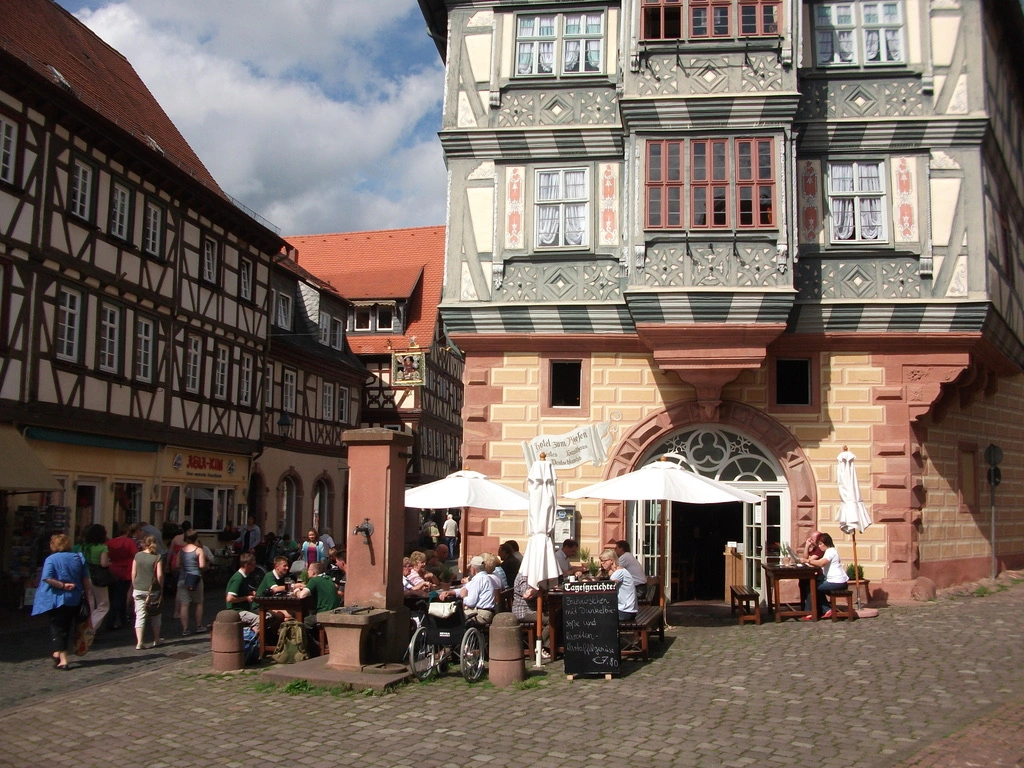
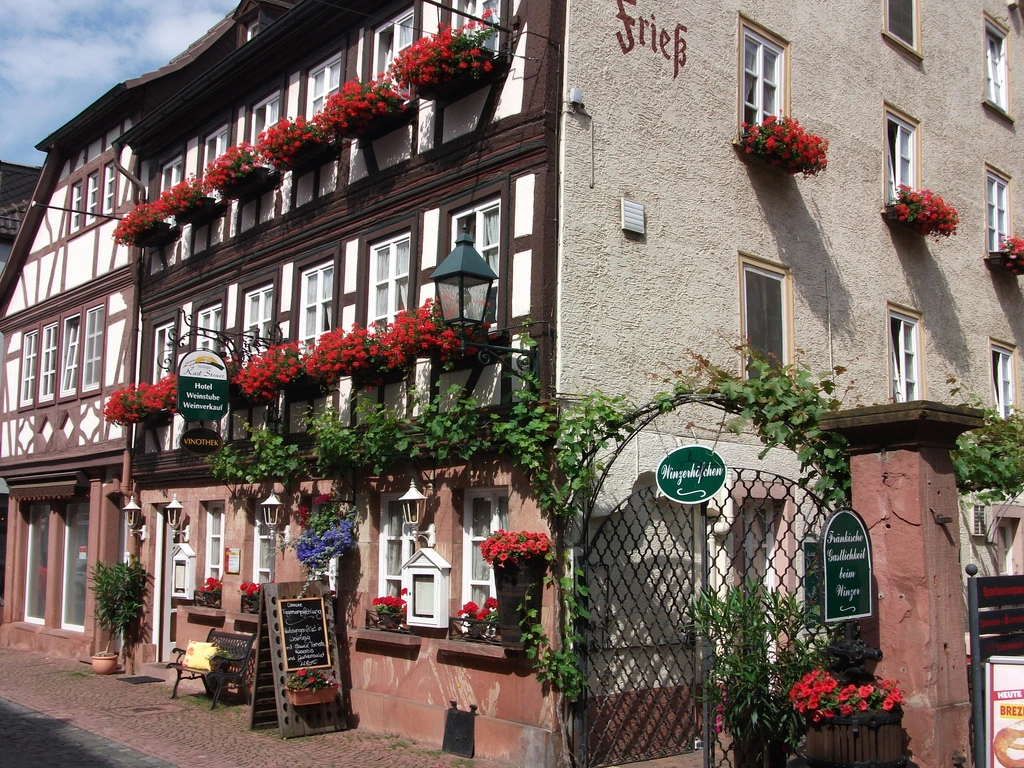
Miltenberg pub with window box geraniums, 18 June 2010
There's another aspect to the anxiety than can inhibit writers and painters: the time it takes.
Unlike my writing, which I do quickly, a painting goes thru several stages and takes quite a bit of time to do. Preliminary sketches, charcoaling lines onto canvas before putting paint on canvas, waiting for layers and sections to dry before further work, etc... at every step there is waiting time - time that can let douts creep into the process and undermine it, or even stop it in its tracks.
The trick is to swat away those douts while waiting for the paint to dry and just finish the thing despite any douts in the offing. Distraction with other work and daily chores helps.
In my case, the time between stints of writing was daily chores, and working in my bookshops. I didn't have time to think about my writing. When I got back to my writing I just plunged strait in and picked up from where I left off. There was no 'time' in which douts could fester and undermine the thrust of my writing. I just got on with it, impatiently, cos daily life and work had kept my mind off my writing in the meantime. After a day's work, and after dinner, my 'writing mind' was still fresh and keen to get cracking - for four hours from 21:00 till 01:00. It was an ideal set-up.
As long as your work isn't too mentally draining, and leaves you enuf time and energy to write, working for your living is good. You can't write or paint 24 hours a day anyway - four hours a day is just about the limit of usefulness, so having work and domestic chores to fill your 'downtime' is also good. It keeps you keen to get on with it once your writing time comes. There's nothing wrong with a bit of urgency to crack the whip!
And if your time is limited, and you have to get cracking, that helps you to not fuss over trifles. You just 'crash it out' as best you can, without straining at gnats, then once you've got a first draft you can tinker with it a bit. I was always surprised at how little I needed to tweak my first draft - add to, subtract from, tidy up, re-position, etc.
There's something about the unity of a fast draft that makes it hang together. Its own urgency gives it unity and conviction. Hesitancy in execution is usually evident, and can see a work undermine itself disastrously. Being slow and hesitant doesn’t make anything any better.
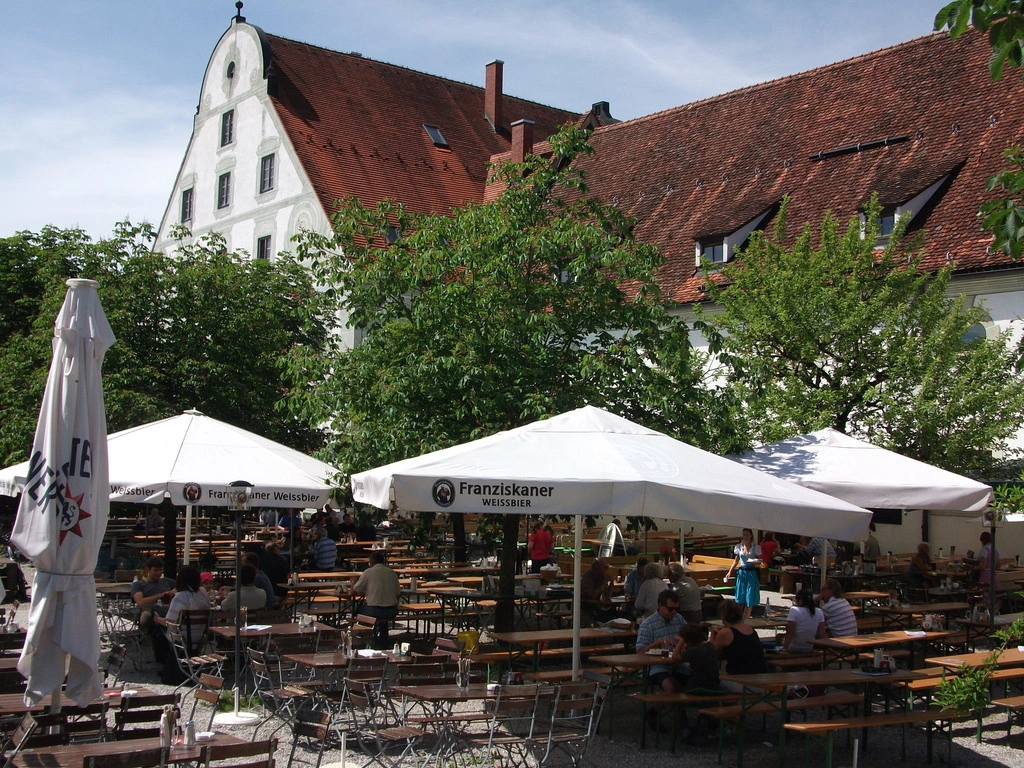
Benediktbeuern Kloster (monastery) Biergarten - the famed monastery of Carmina Burana fame, where a collection of old medieval student drinking songs in Medieval Latin and Middle High German was found in 1803, on which Carl Orff based his 1937 cantata Carmina Burana - Burana being the Latin for Beuern. 15 June 2012. A reminder among many in Germany that the medieval Church was a great beer brewer and in its own way was anything but puritanical.
I can't imagine being a 'full-time writer'. I expect it wd dissipate energy rather than concentrate it. As long as your work doesn't consume you, it's good to have to work for your living. It keeps you connected to the world, and hones your wits for when you do have your 'writing time'. It's a question of balance.
I was lucky. My work in my secondhand bookshops was stimulating but allowed me enuf time and energy to get up a body of work. I dout I'd've done any more or better if I hadn't had to work.
I always had good instincts about sheltering and enabling my writing gift. I dropped out of law, feeling the way it used language was inimical to my creative writing. Ditto for academia. The law and academia are the death of real writing.
I avoided all-consuming work that wdv stymied my writing energies. I managed to find work in secondhand bookshops that complemented rather than contested with my writing self. Having to broaden my general knowledge to be more commercially useful in buying and selling books was a very useful experience and a fillip to my mind that I found invaluable.
The commerce of buying and selling, and becoming very good at it, also sharpened my wits and my sense of what makes people tick - no bad thing for an author. I can assure you there's nothing 'ivory tower' about working in a secondhand bookshop! It's very fysical - hoicking boxes of books is real grunt work - specially when you're fetching them from people's houses and flats when you're buying them.
You've also got to be canny. You've got to know a bit about 'everything' if you are to evaluate all the books you are offered. You buy from and sell to 'the public' at your prices. Your general knowledge becomes your stock in trade, and it never stops expanding. You become a Jack of All Trades. A generalist is almost uncalled for these days, where most jobs are highly specialised. But being a generalist is no bad thing for a writer.
And, believe it or not, buying and selling secondhand books gives you better bullshit detecters for appraising your own work, and that of others. It sharpens your judgment. No bad thing. I always felt that if my own work survived my own bullshit detecters it was worthwhile, even if publisher after publisher knocked me back. I had faith in my work, even if others didn't. That gave me strength and resilience against the odds of constant rejection. I wasn’t going to let the endless knock-backs make me miserable or make me think less of my work. I loved my life and I loved my works. And if that had to be it, well so be it.
Main River and bikepath at Miltenberg, 18 June 2010